
기본 개념부터 합병증 관리까지
4개의 최신 논문을 기반으로 thread lifting의 재료, 기본 역학, 해부학적 고려사항, 합병증 관리를 종합 정리합니다.
Part 1 - Thread Materials
Silicone, Gold, PDO, PLLA, PCL, Mesh scaffold
Part 2 - Basic Concepts & Mechanics
Fixing/Hanging/Anchoring point, I/U/V-type design
Part 3 - Anatomical Considerations
Vascular, Neural, Ligaments, Fat compartments
Part 4 - Complications
Dimpling, Migration, Protrusion, Nerve damage
References: Hong et al. (2024) ×2, Hong et al. (2025), Yi & Park (2025)
1990년대: Sulamanidze의 APTOS thread
Non-absorbable polypropylene cog thread의 등장. Thread lifting의 개념을 정립.
2000년대: Silicone & Gold thread
Silicone-coated braided thread, gold thread 등 다양한 소재 시도. 합병증과 한계로 점차 쇠퇴.
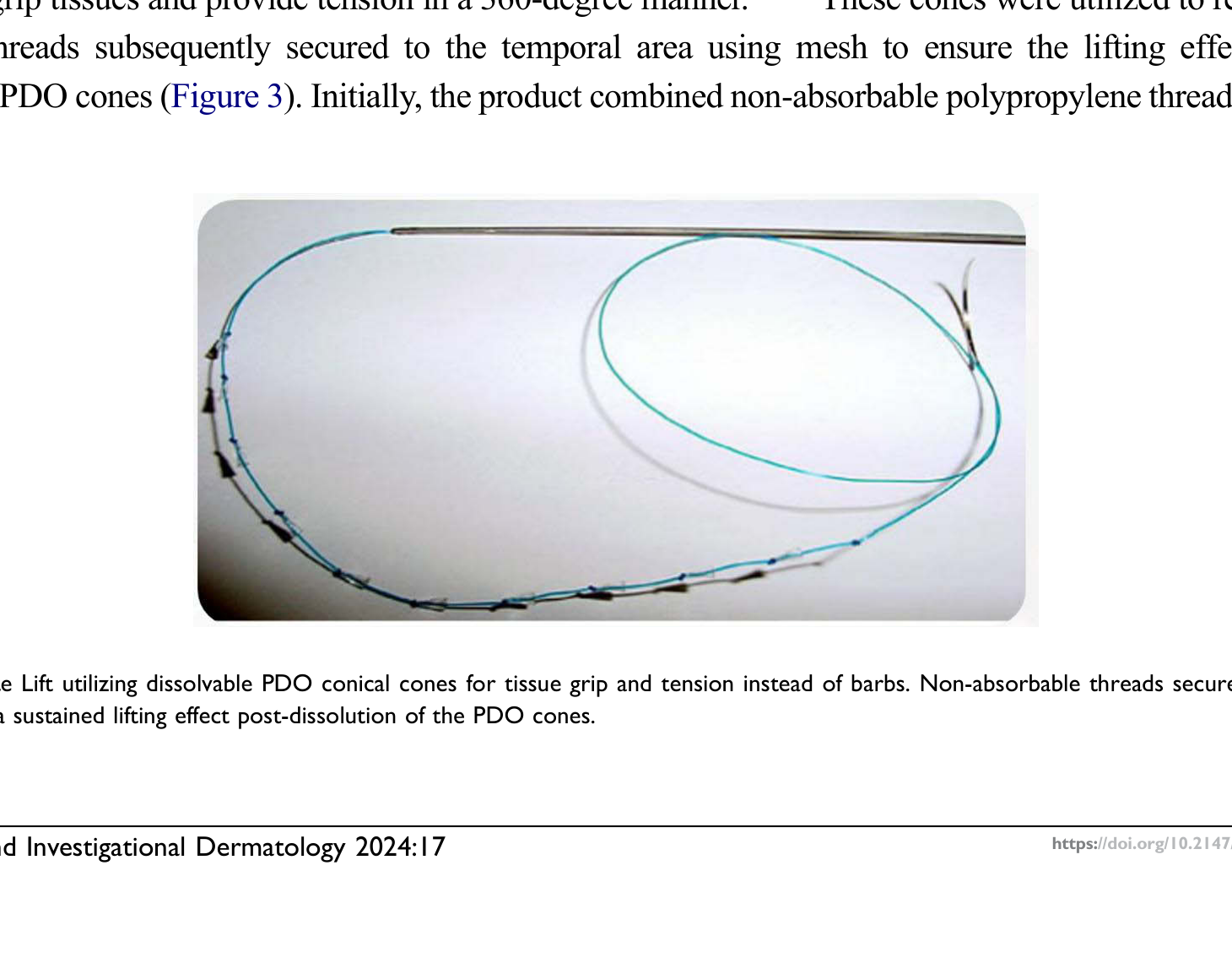
2006: Silhouette Lift (Cone suture)
PLLA cone을 이용한 anchoring mechanism. 이후 absorbable 소재로 전환.
2010년대~현재: Absorbable materials
PDO, PLLA, PCL 기반 cog thread가 주류. Tissue regeneration과 lifting 동시 달성.
최신: Mesh scaffold (TESSLIFT)
Thread + mesh 결합. 넓은 면적의 tissue integration과 강력한 holding strength.
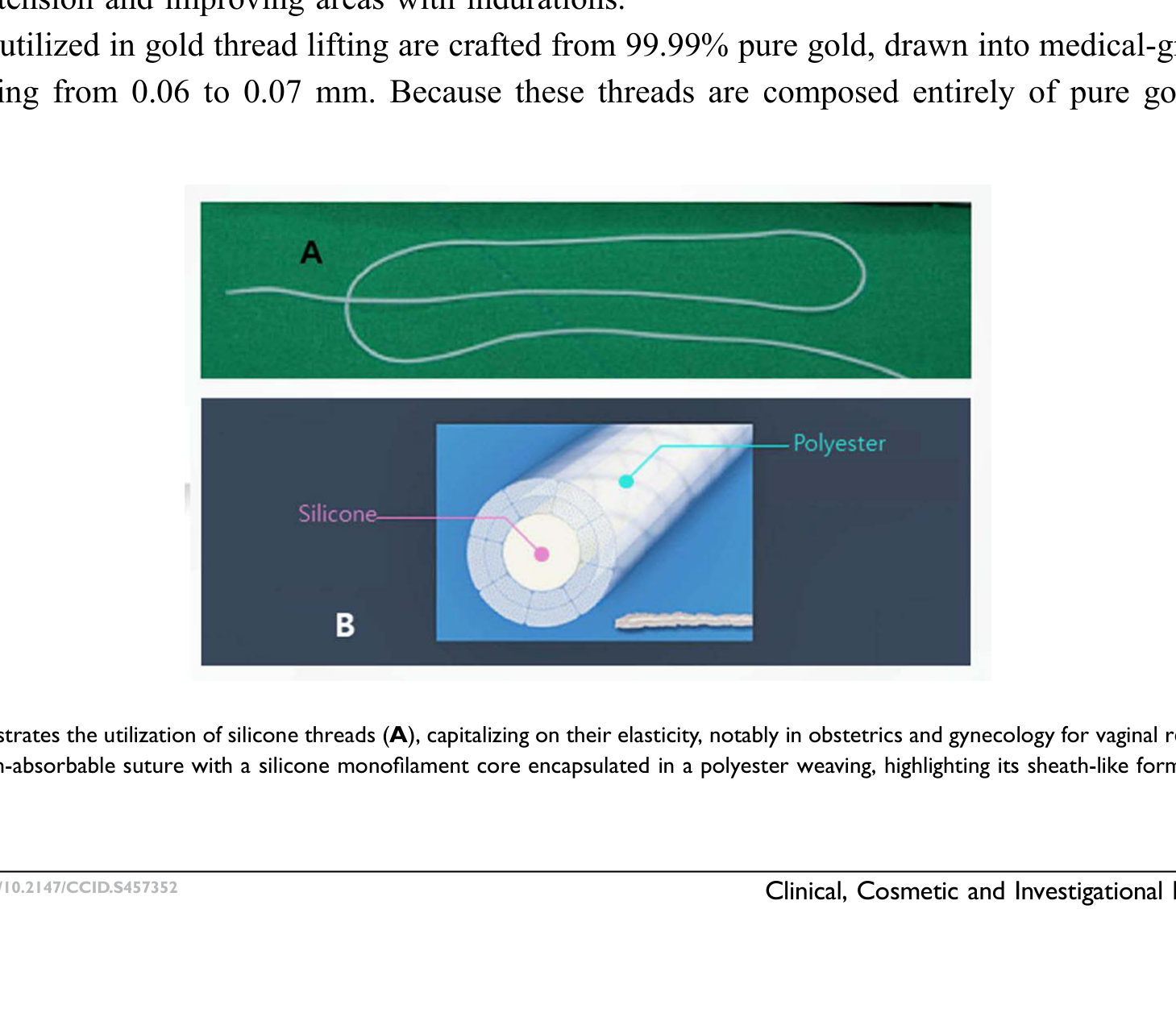
Silicone Thread
- Silicone-coated braided polyester
- Non-absorbable, permanent implant
- 강한 tensile strength
- 단점: foreign body reaction, infection risk, palpability
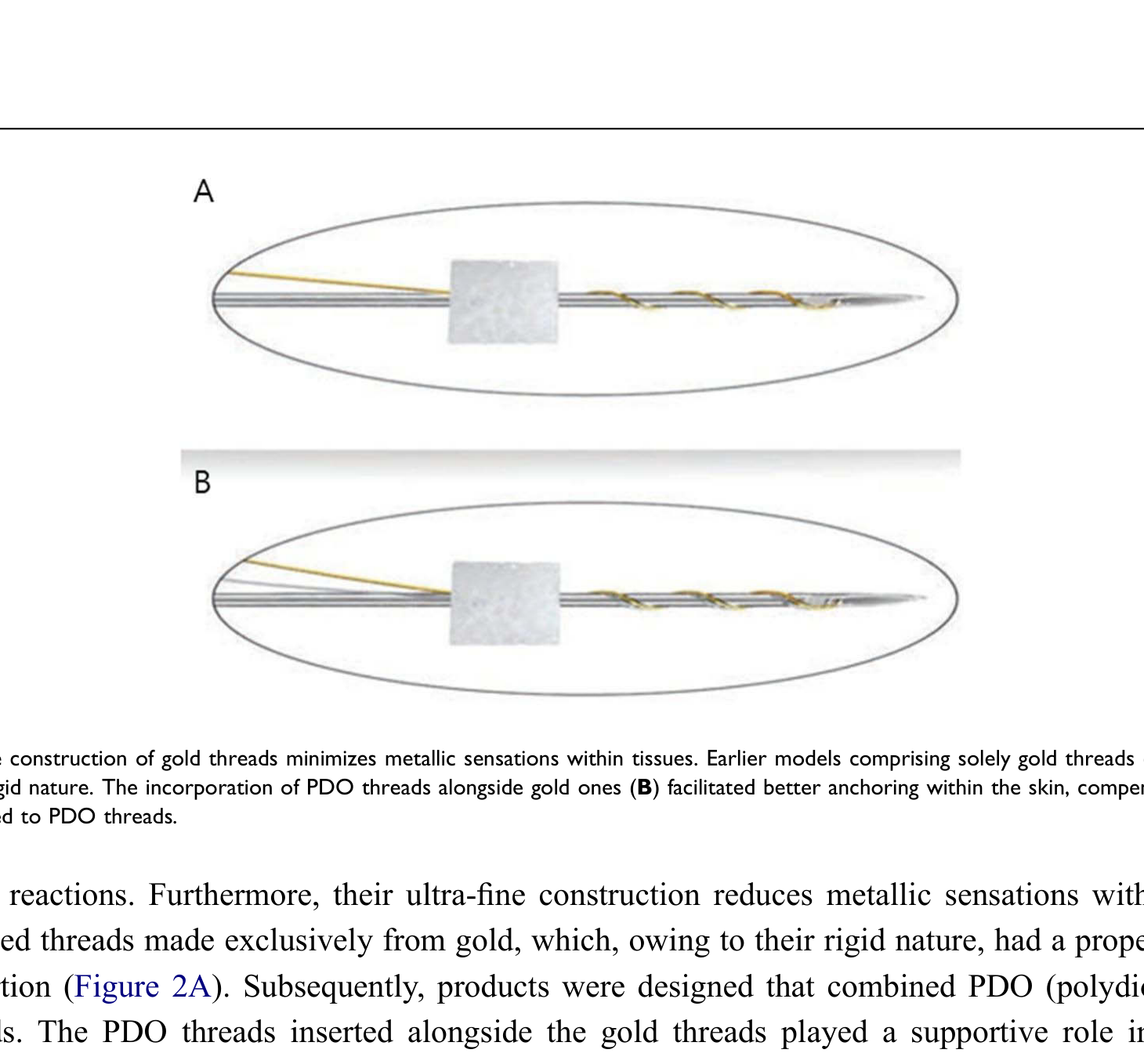
Gold Thread
- 24K gold wire (0.1mm 직경)
- Biocompatible하나 lifting 효과 제한적
- 주로 tissue rejuvenation 목적
- 단점: migration, MRI 간섭, granuloma
→ 현재는 non-absorbable thread의 사용이 크게 감소. Absorbable materials가 주류.
PDO
- Absorption: 6~8개월
- 가장 널리 사용
- Collagen type I stimulation
- 상대적으로 빠른 흡수
PLLA
- Absorption: 12~18개월
- 강한 tissue stimulation
- Collagen neogenesis 우수
- Silhouette Instalift (cone)
PCL
- Absorption: 24~36개월
- 가장 긴 지속 기간
- 유연한 물성
- 지속적 collagen 생성
핵심: High-quality absorbable cog thread는 lifting + tissue regeneration을 동시에 제공. 흡수 후에도 collagen capsule이 효과를 유지.
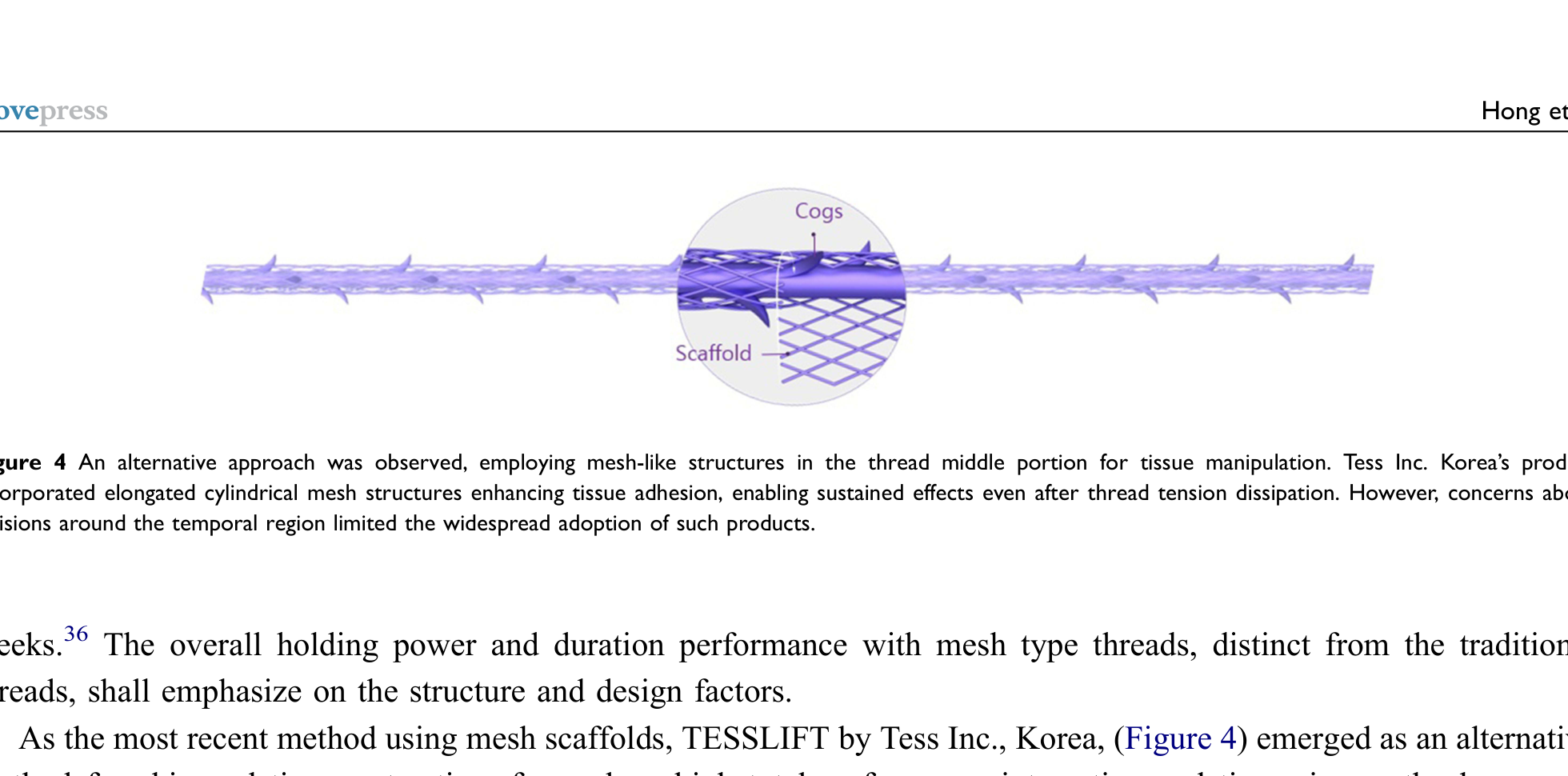
구조
Central barbed thread + surrounding mesh sleeve. PDO 또는 PCL 기반.
장점
- 넓은 면적의 tissue integration
- 우수한 holding strength
- Volume effect (mesh 내 tissue ingrowth)
- Collagen stimulation 면적 극대화
적응증
중등도 이상의 facial laxity, jawline definition, midface lifting
| Non-absorbable | Absorbable | |
|---|---|---|
| 지속 기간 | Permanent | 6~36개월 (소재별 차이) |
| Tissue regeneration | 없음 | Collagen neogenesis |
| 합병증 | Migration, infection, palpation | 상대적으로 적음 |
| 재시술 | 제거 어려움 | 자연 흡수 후 재시술 가능 |
| 현재 트렌드 | 사용 감소 | 주류 |
Meta-analysis 결과
Absorbable thread가 non-absorbable 대비 합병증 발생률이 낮고, tissue regeneration 효과로 장기적 환자 만족도가 높음.
Thread Thickness
두꺼울수록 tensile strength ↑, 하지만 insertion difficulty ↑ 및 palpation risk ↑
Cog Design
Uni-directional vs bi-directional. Cog 각도, 깊이, 간격이 anchoring strength 결정
Material Selection
목표 지속 기간에 따라 PDO (단기) / PLLA (중기) / PCL (장기) 선택
Tension & Elasticity
과도한 tension → dimpling, 부족한 tension → 효과 미미. 적절한 balance가 핵심
Key point: 단일 요소가 아닌 thickness, cog design, material, tension의 종합적 고려가 필요.
Fixing Point
Thread의 proximal end가 고정되는 지점. 일반적으로 temporal area의 deep temporal fascia에 고정.
Hanging Point
Thread가 sagging tissue를 잡아 올리는 중간 지점. Cog가 tissue에 anchoring되는 부위.
Anchoring Point
Thread의 distal end가 위치하는 지점. 효과적인 벡터 형성의 시작점.
핵심: Fixing point → Hanging point → Anchoring point 순서로 lifting vector가 형성됨. 각 point의 위치 선정이 결과를 좌우.
Tensile Strength
Thread 자체의 인장 강도. Thread가 끊어지지 않고 견딜 수 있는 최대 장력.
Thread 고유 물성
Anchoring Strength
Cog가 tissue에 고정되는 힘. Cog angle, depth, design에 의해 결정.
Cog-Tissue 상호작용
Holding Strength
시간 경과에 따른 lifting 효과 유지력. Tissue integration, fibrosis 정도에 영향.
장기 효과
Tensile strength가 높아도 anchoring strength가 낮으면 thread가 미끄러져 효과 소실. 세 가지 strength의 균형이 중요.
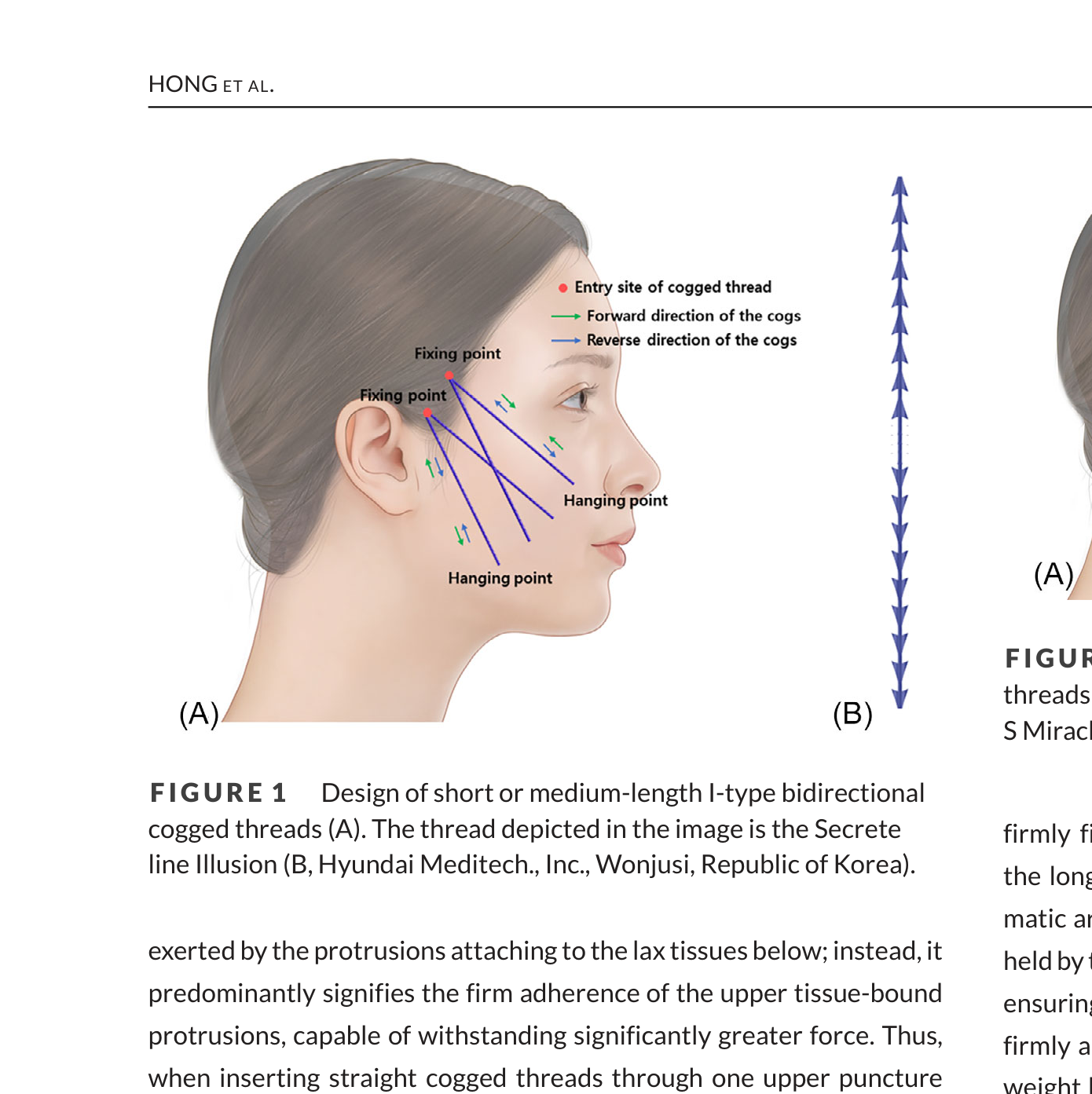
특징
- Single needle, bidirectional cog 배열
- 중앙 convergence point 기준으로 양방향 cog
- 양쪽에서 동시에 tissue anchoring
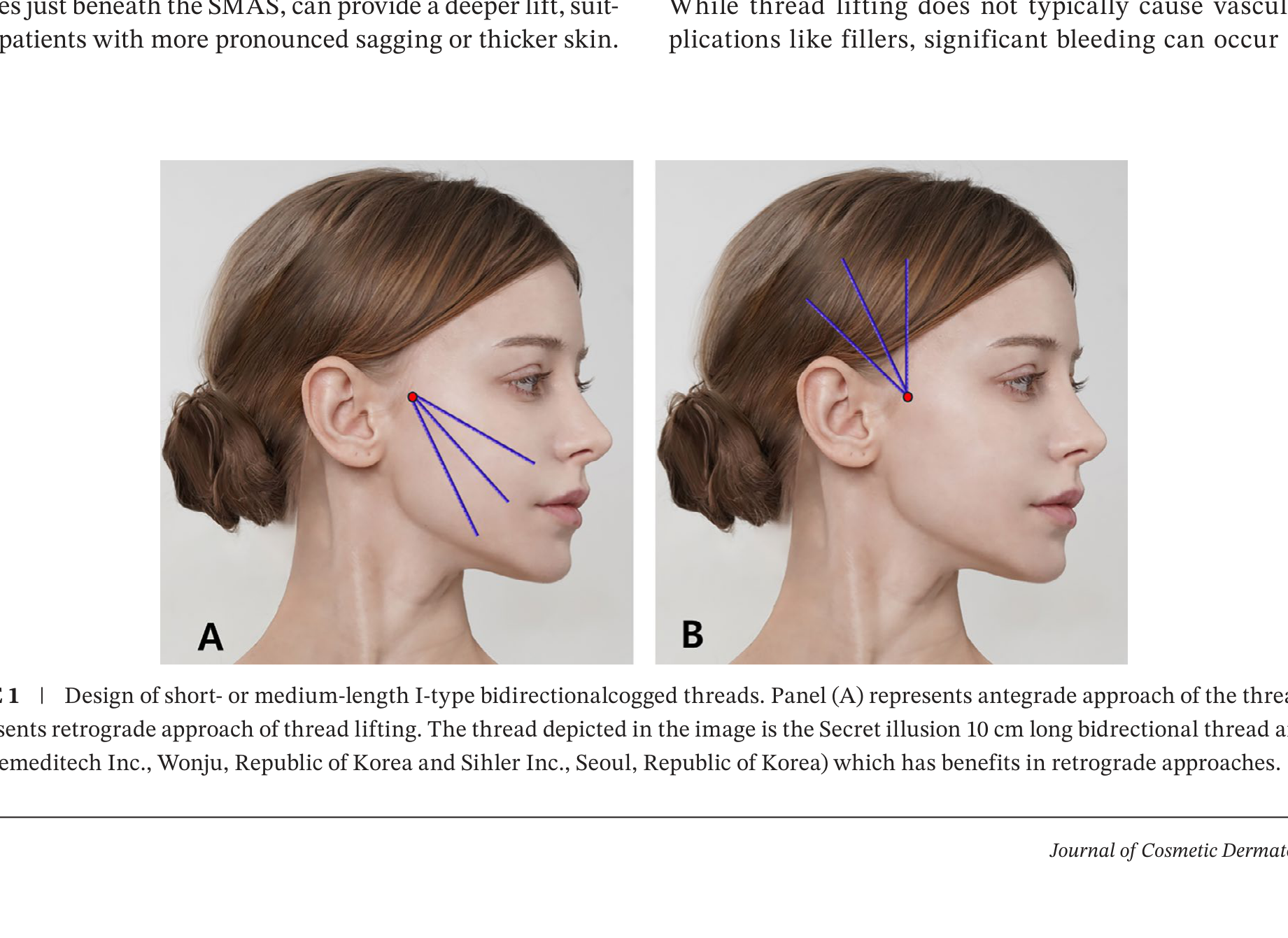
적용: Lateral Facial Lifting
- Temporal area → midface/lower face로 삽입
- Bidirectional cog가 자체적으로 tension 생성
- 별도의 fixation point 불필요
장점: Simple insertion, self-anchoring mechanism
주의: Unidirectional 대비 vector 조절 유연성 제한
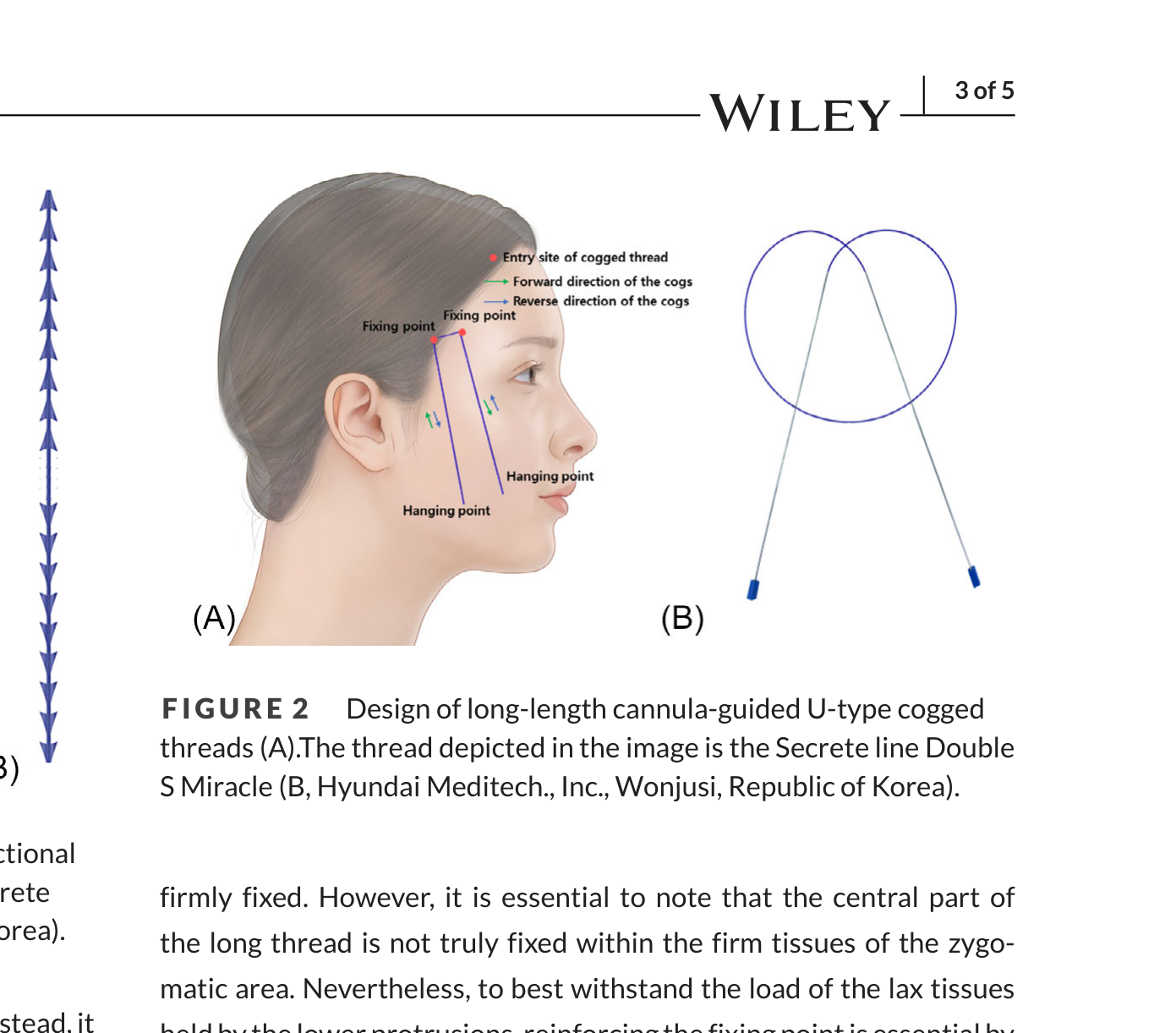
특징
- Cannula를 사용한 U자형 경로 삽입
- Entry point → U-turn → Exit point
- 넓은 면적의 tissue engagement
적용: Lateral Facial Lifting
- Temporal area에서 진입, midface를 돌아 다시 올라옴
- 양쪽 end 모두 temporal area에 고정
- 강력한 anchoring + 넓은 coverage
장점: Strong fixation, wide lifting area, adjustable tension
주의: Cannula manipulation 숙련도 필요, vascular injury risk
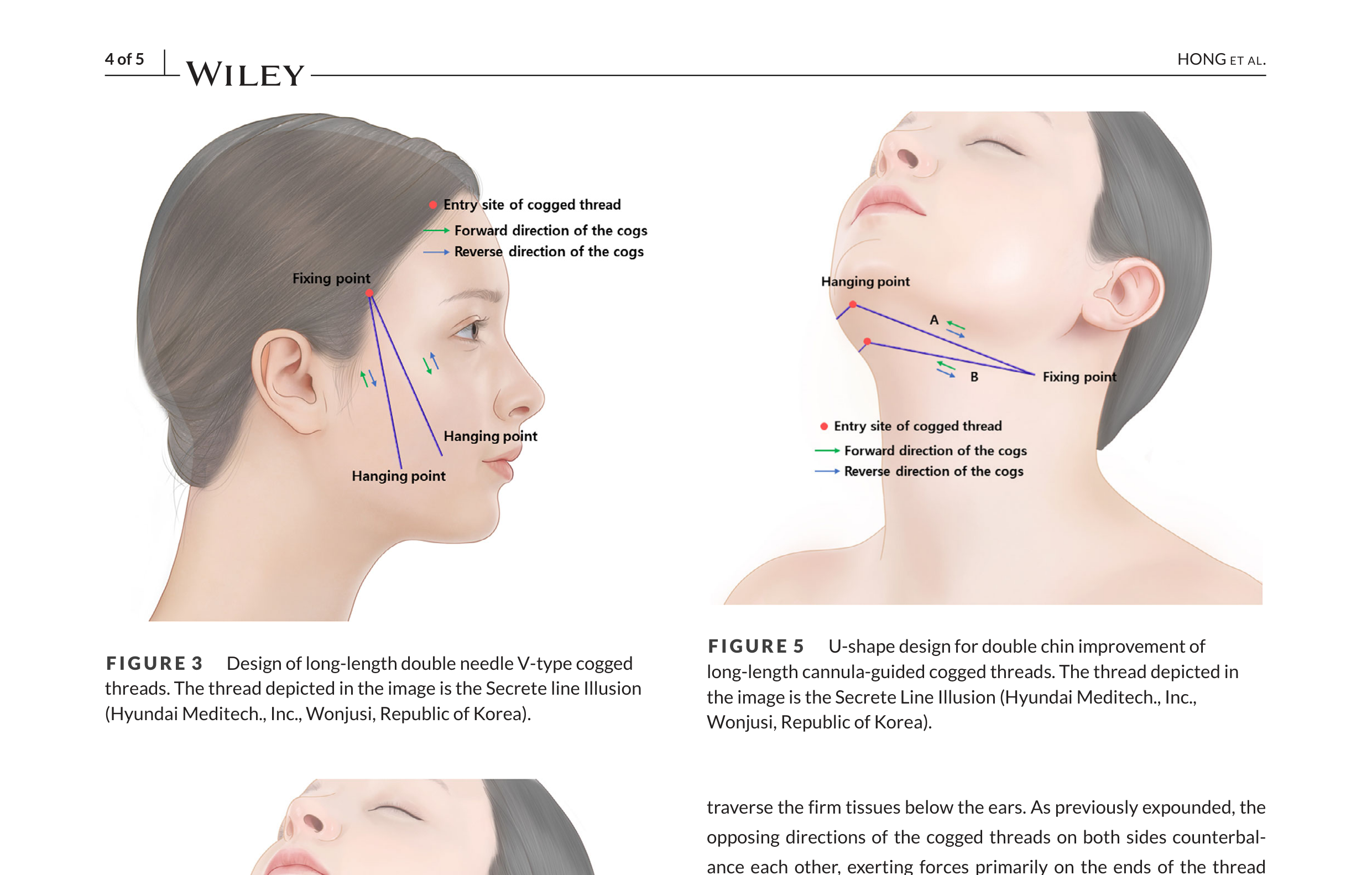
특징
- 양 끝에 각각 needle이 있는 V자형 구조
- 두 개의 insertion trajectory 형성
- V자 꼭짓점이 anchoring point 역할
적용: Midface & Jawline Lifting
- 두 방향으로 동시 삽입 → 넓은 lifting vector
- Fan-shaped tissue engagement
- Midface volume redistribution에 효과적
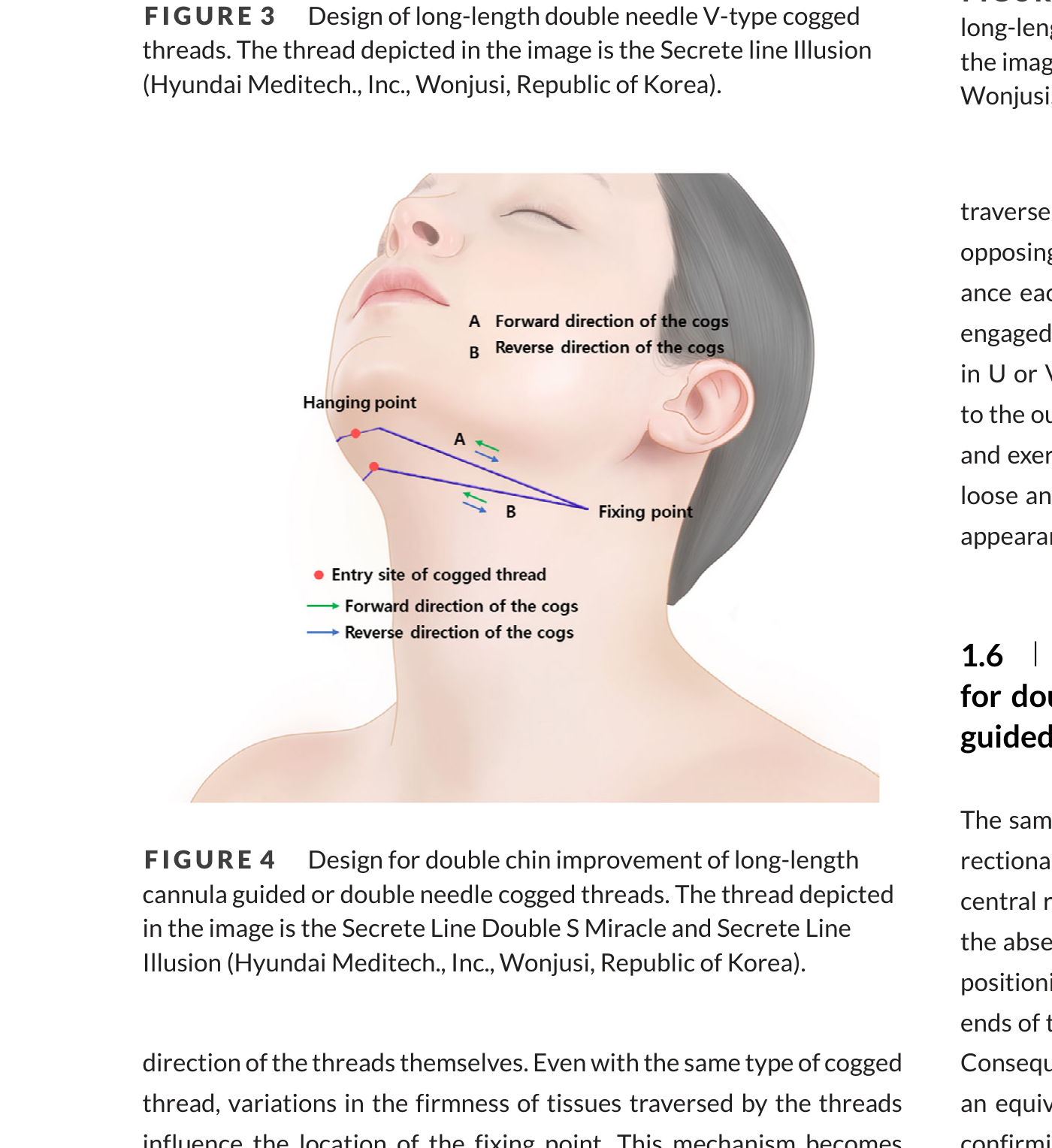
I-shape Design
- Submental area에서 vertical 방향으로 삽입
- Bidirectional cog로 submental fat과 skin을 상방 견인
- Platysma band 개선에도 효과적
시술 포인트
- Fixing point: mastoid area 또는 mandible angle
- Thread direction: vertical to slightly oblique
- 주의: marginal mandibular nerve 손상 방지
Key takeaway: Thread 방향보다 tissue consistency(조직 상태, 지방량, 피부 탄력)가 결과를 더 크게 좌우함.
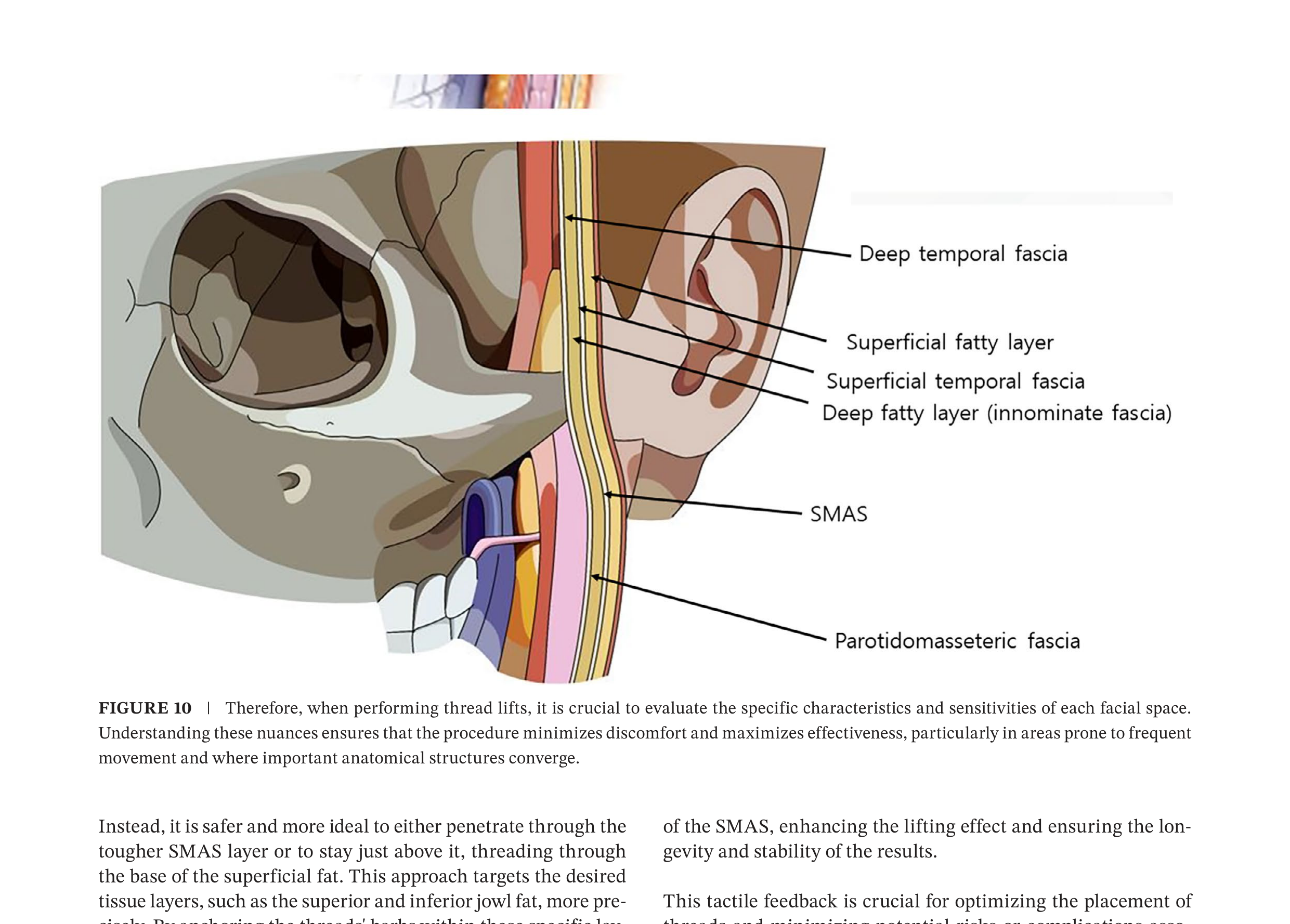
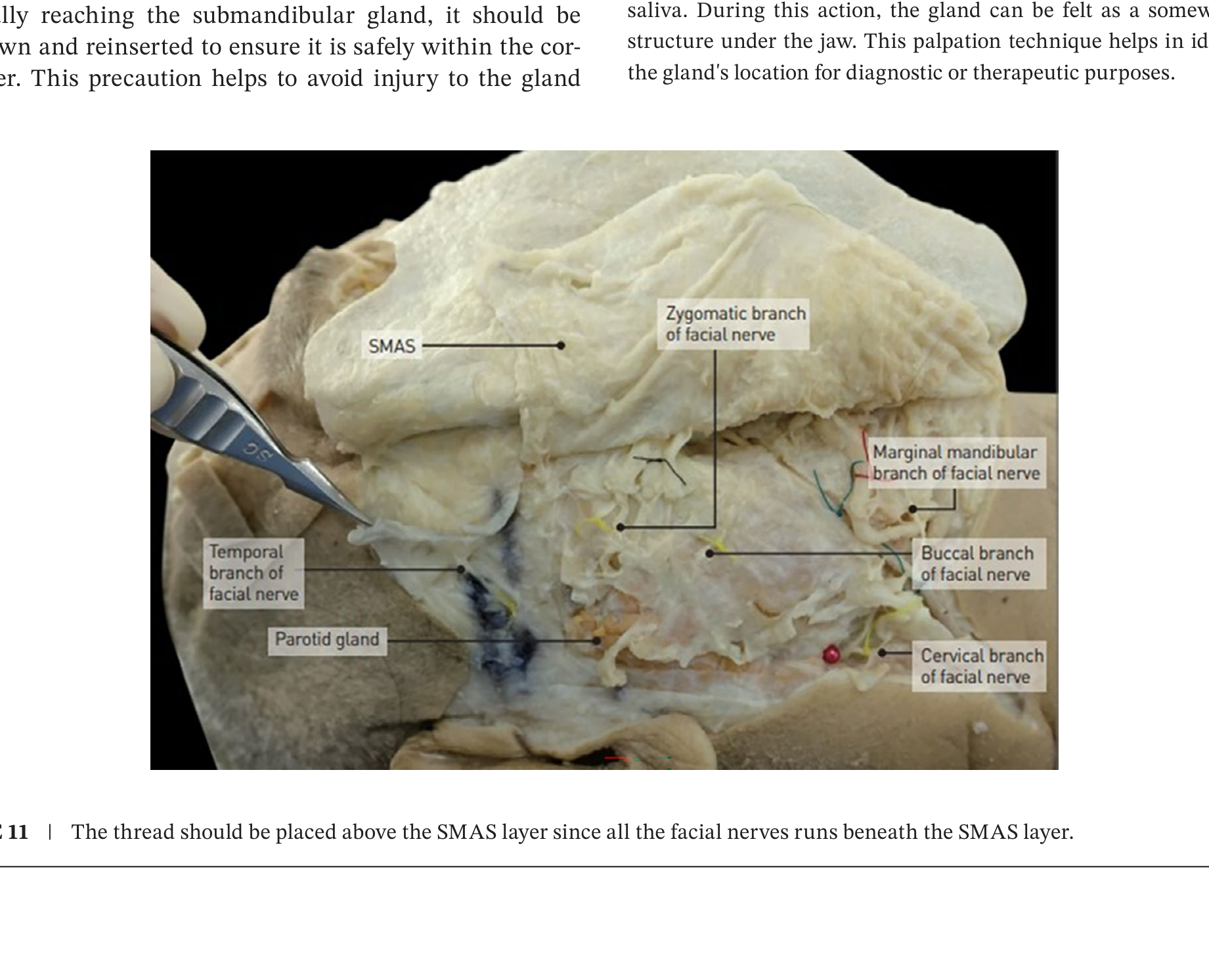
Supra-SMAS Placement 권장
- Thread는 SMAS 상방 (subcutaneous layer)에 위치시키는 것이 안전
- Sub-SMAS insertion: facial nerve injury risk ↑↑
- Supra-SMAS에서도 충분한 lifting 효과 달성 가능
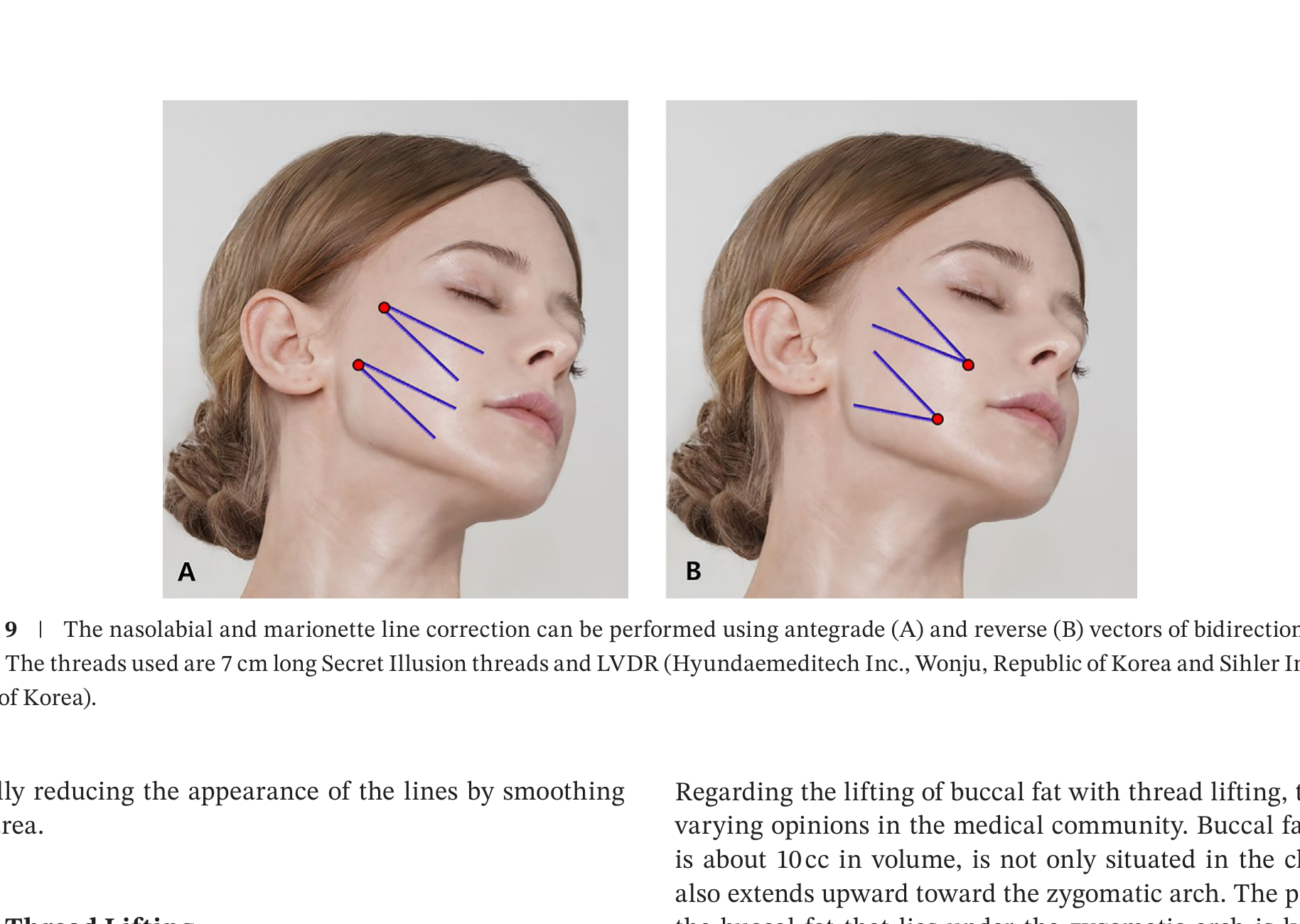
Antegrade Approach
Temporal area → lower face 방향. Fixing point에서 anchoring point로 순방향 삽입.
Retrograde Approach
Lower face → temporal area 방향. Cannula로 경로 확보 후 thread를 역방향 배치.
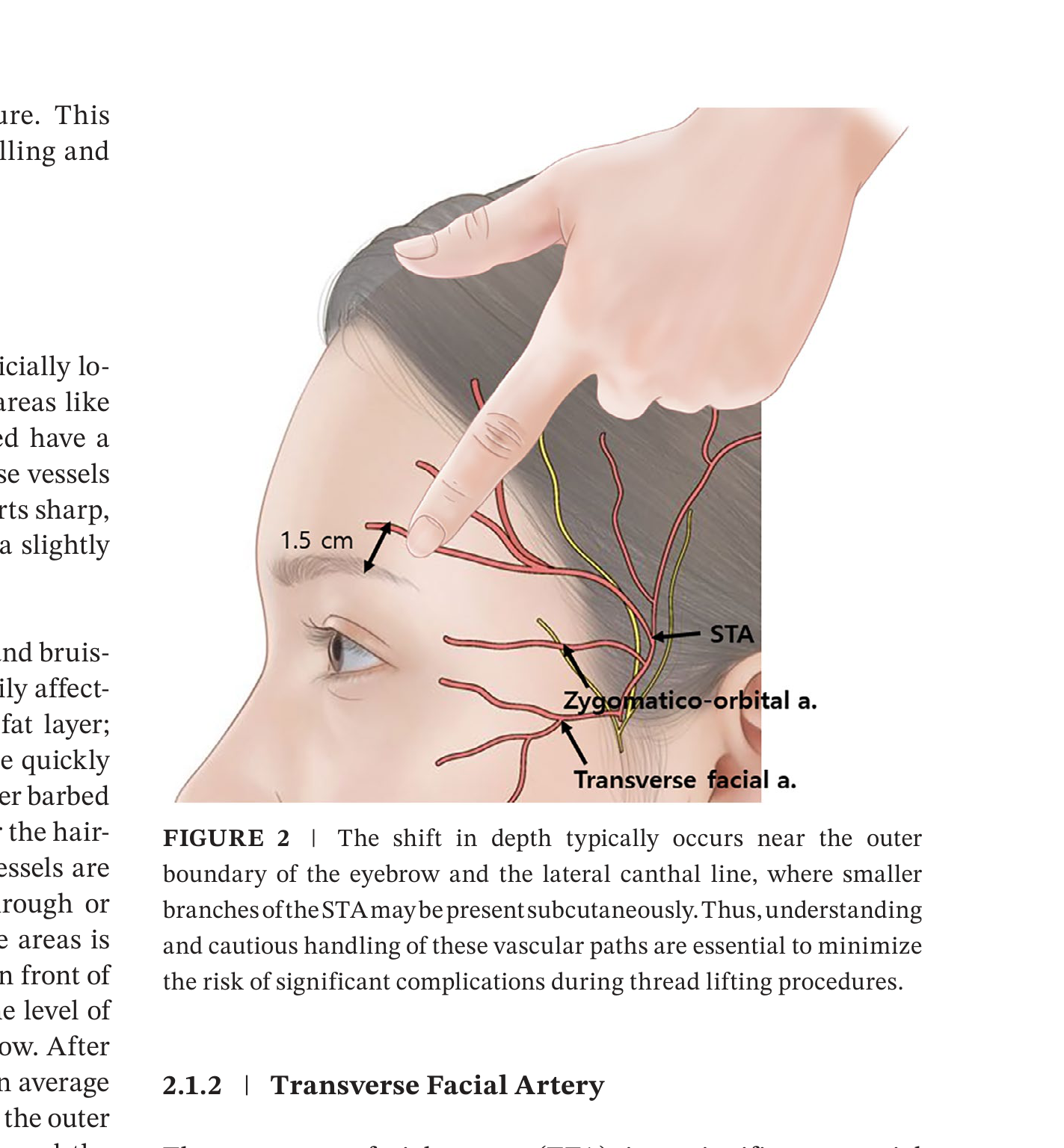
STA (Superficial Temporal Artery)
- External carotid artery의 terminal branch
- Temporal area에서 subcutaneous layer를 주행
- Thread insertion 시 가장 먼저 만나는 주요 혈관
주의사항
- Entry point 선정 시 STA pulsation 확인 필수
- STA 주행 경로를 피해 thread 삽입
- Transillumination이나 ultrasound로 사전 확인 권장
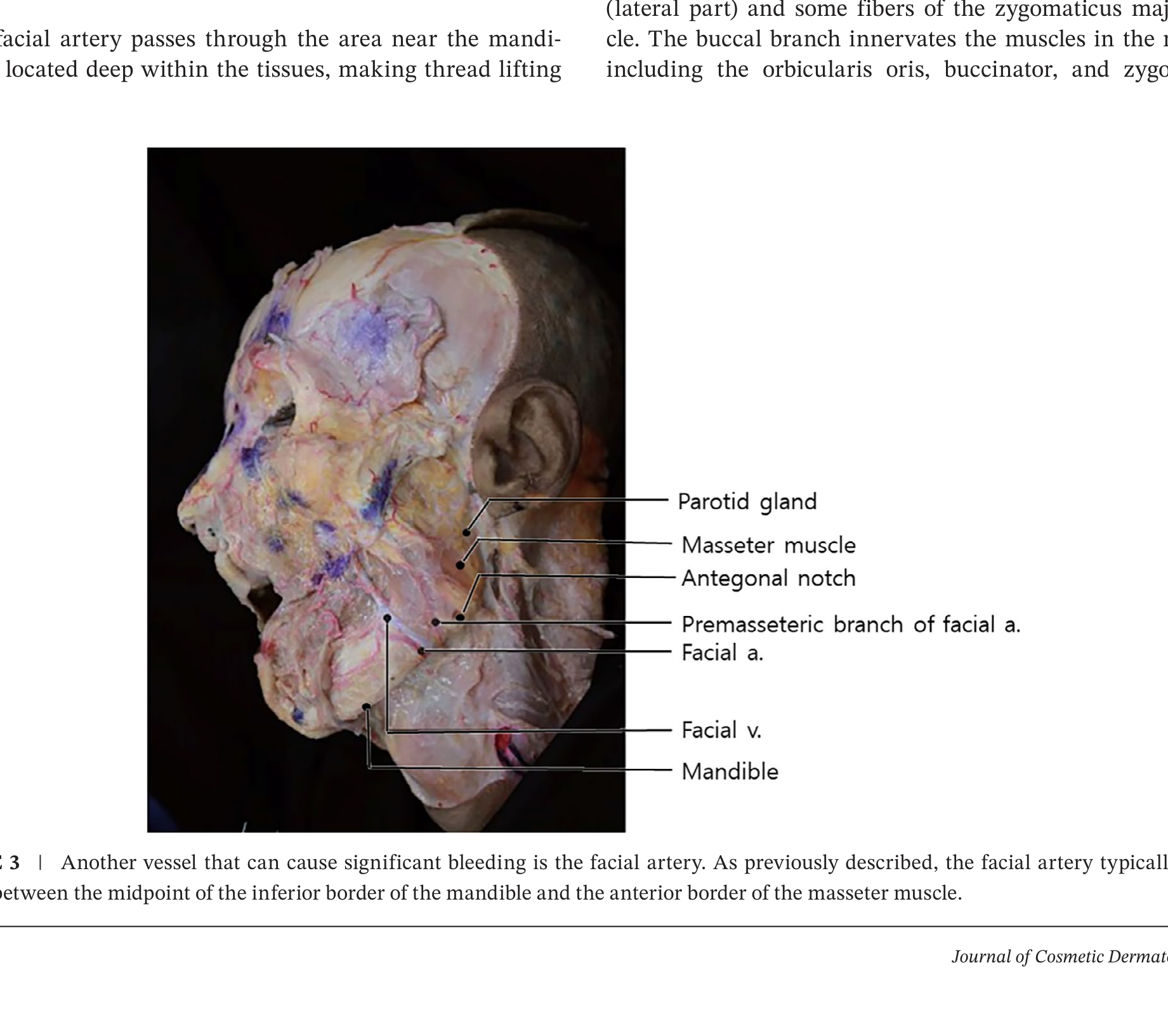
TFA (Transverse Facial Artery)
Parotid gland 상방, zygomatic arch 하방을 주행. Midface thread insertion 시 주의.
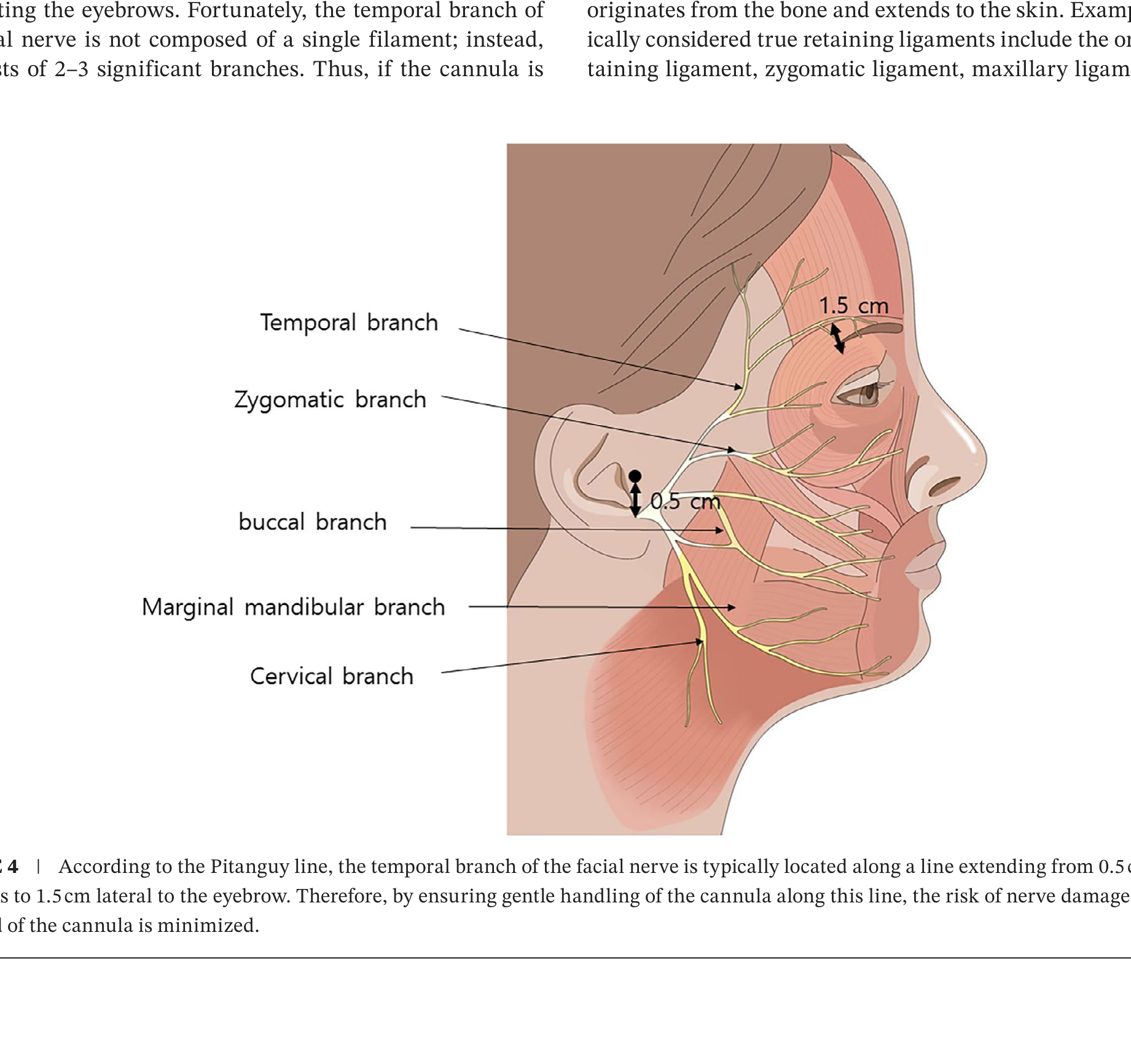
Facial Nerve Branches
- Temporal branch: frontalis muscle 지배. Zygomatic arch 상방 주행
- Zygomatic branch: orbicularis oculi 지배
- Buccal branch: buccinator, orbicularis oris
- Marginal mandibular: depressor anguli oris. 손상 시 mouth asymmetry
Pitanguy Line
Tragus 아래 0.5cm → lateral canthus 방향의 선. Temporal branch의 주행 경로를 나타내는 landmark.
GAN (Great Auricular Nerve)
Erb's point에서 기시. SCM 후연을 따라 상행하여 ear lobule로. Thread lifting 시 6% injury rate.
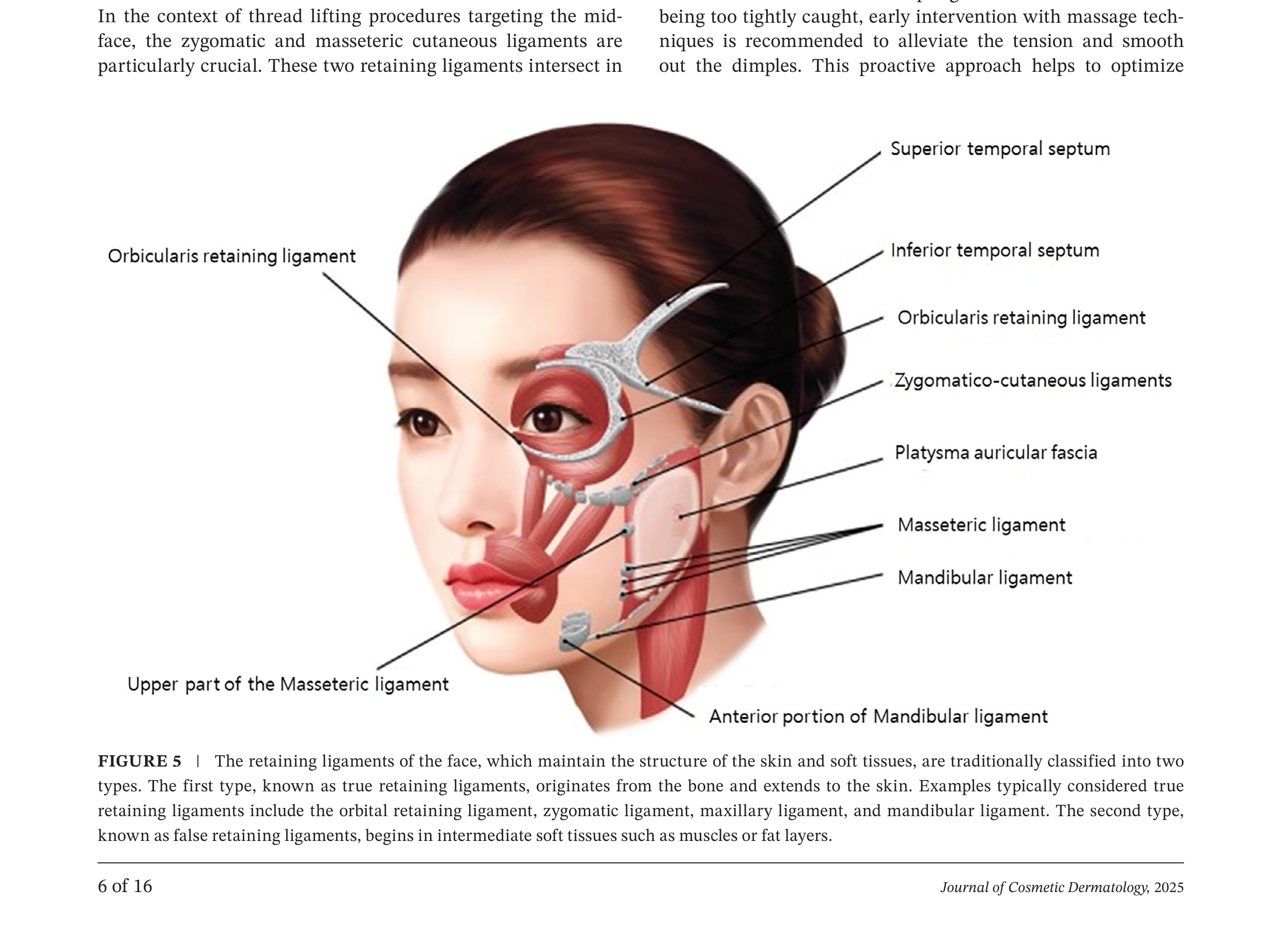
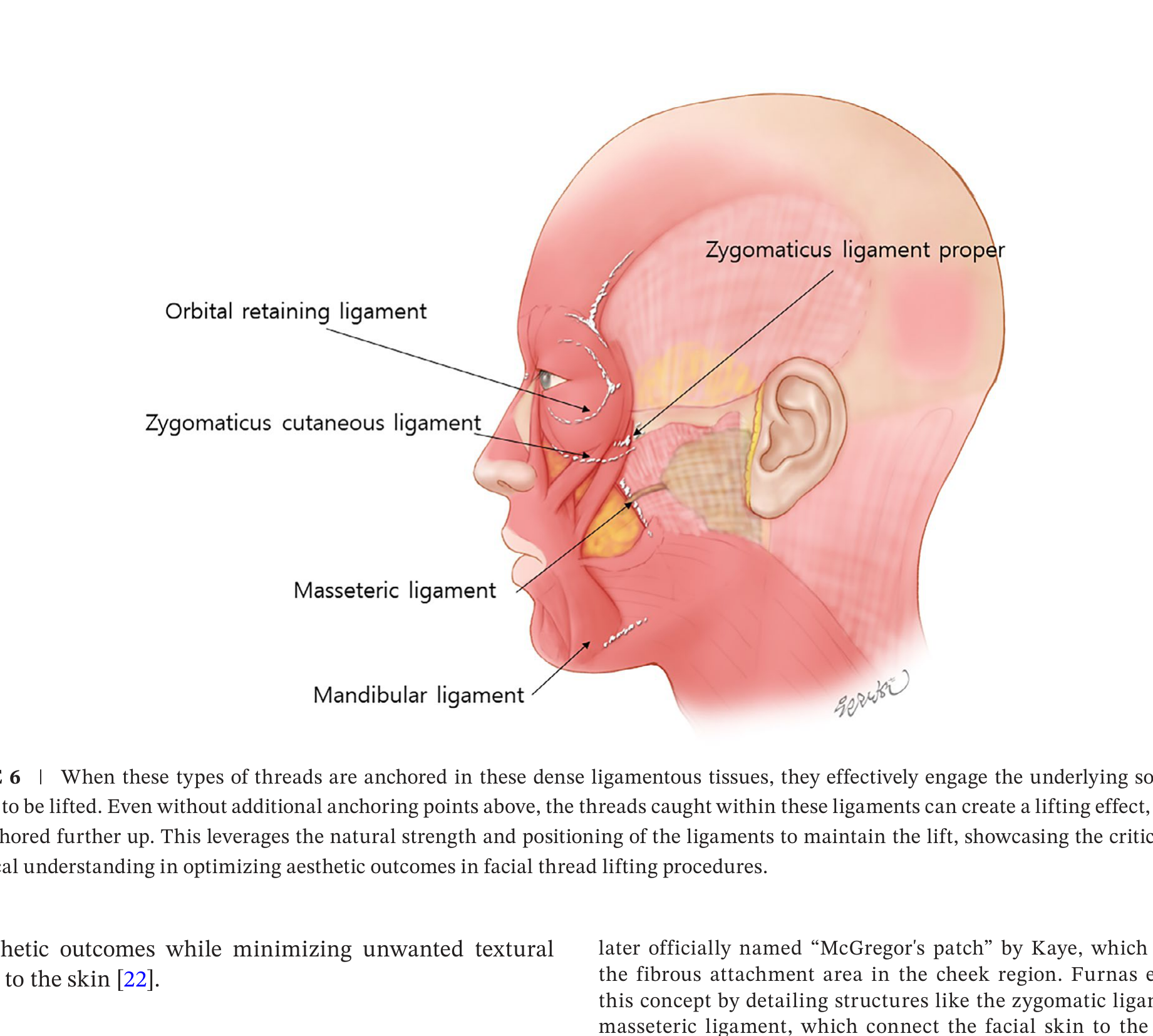
True Ligaments
- Periosteum → skin 직접 연결
- Zygomatic ligament
- Mandibular ligament
- 강한 고정력, thread의 anchoring point로 활용
False Ligaments (Septae)
- SMAS → skin 연결 (fascia 기원)
- Parotid-cutaneous ligament
- Masseteric-cutaneous ligament
- 상대적으로 약하지만 지지 구조 역할
임상 의의: Ligaments의 line of ligaments를 이해하고, thread가 이 구조를 활용하여 anchoring하면 효과 극대화.
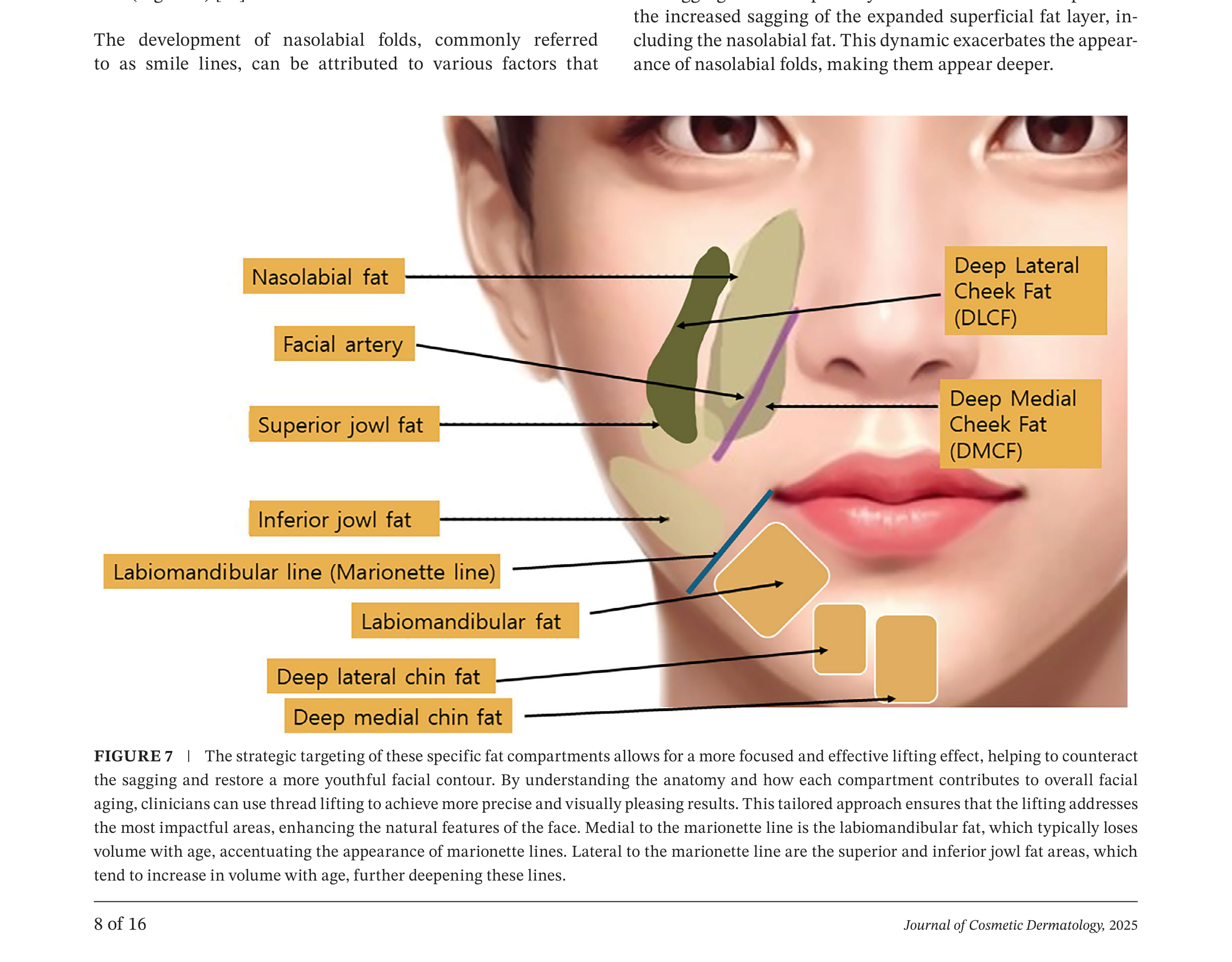
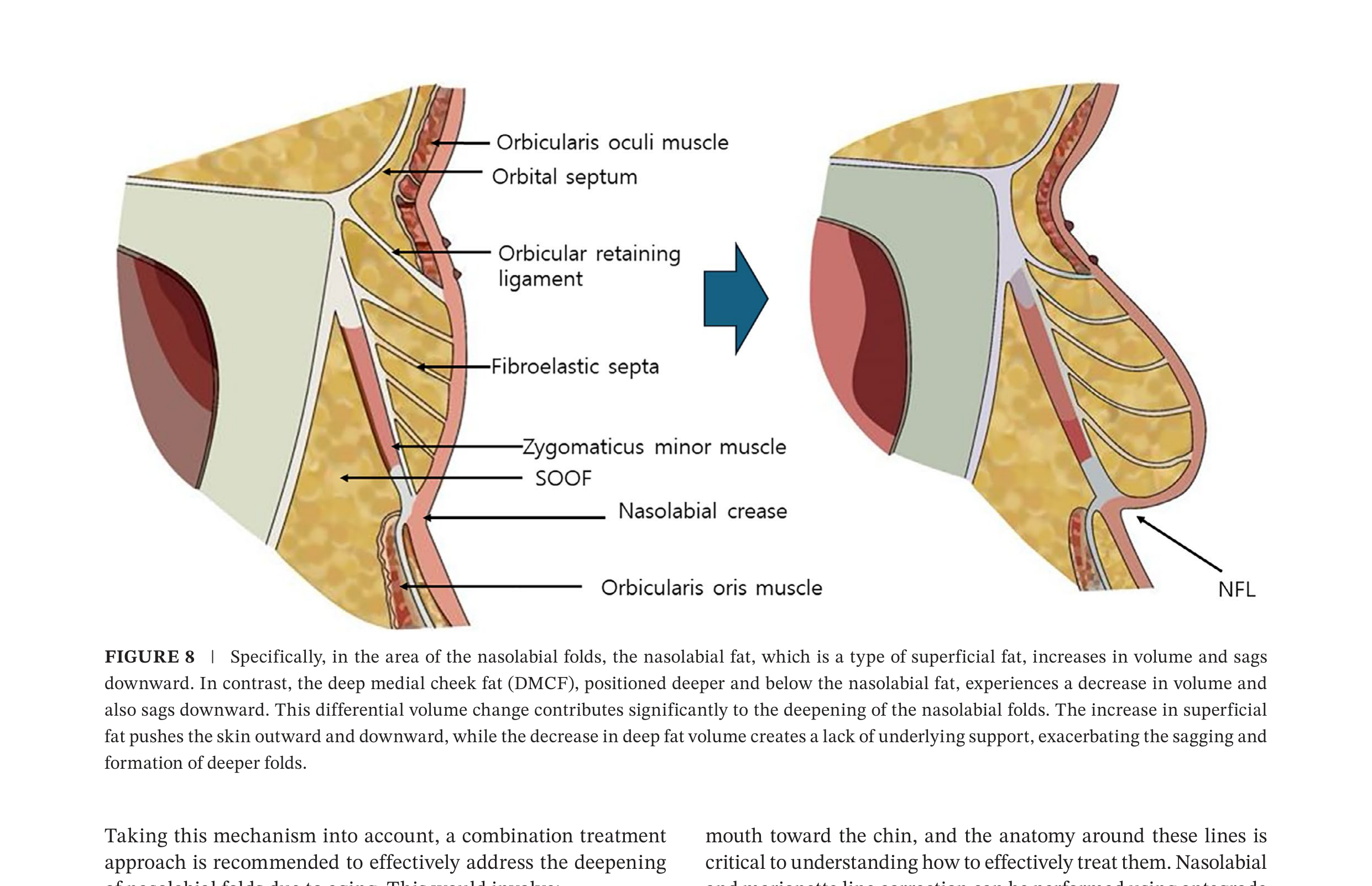
Compartmental Aging Theory
각 fat compartment가 독립적으로 노화 (volume loss/gain). 균일한 aging이 아닌 차등적 위축과 이동이 발생.
Superficial Compartments
- Nasolabial fat
- Medial/Middle/Lateral cheek fat
- Jowl fat
Deep Compartments
- Medial/Lateral SOOF
- Deep medial cheek fat (Bichat)
- Buccal fat pad
시사점: Thread lifting 단독보다 filler, toxin과의 combination therapy가 compartmental aging에 효과적.
Premasseteric Space
- Masseter 전방의 potential space
- Facial artery, buccal fat pad과 인접
- Thread가 이 space에 진입 시 migration risk ↑
Buccal Fat Capsule
Buccal fat pad의 capsule이 thread anchoring의 target tissue가 될 수 있으나, 과도한 manipulation은 fat herniation 유발 가능.
핵심: Facial spaces의 경계를 숙지하고, thread가 의도치 않게 space 내로 진입하지 않도록 depth control 필수.
Parotid Gland
- SMAS 심부에 위치, facial nerve가 gland 내를 관통
- Thread가 parotid capsule을 관통 시 sialocele 발생 가능
- Preauricular area에서의 thread insertion 시 특히 주의
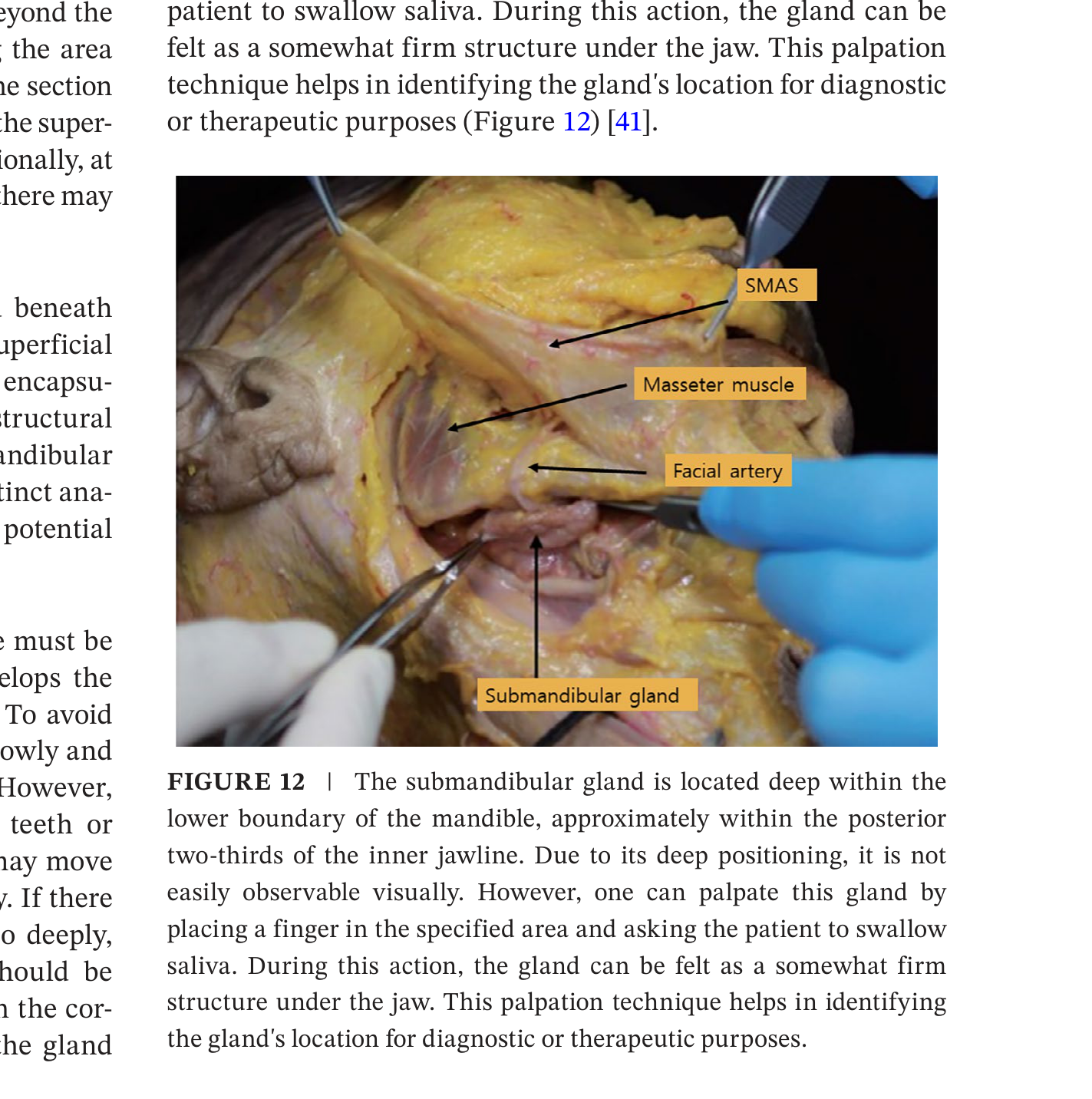
Submandibular Gland
- Mandible body 하방에 위치
- Neck/submental thread lifting 시 gland injury risk
- 적절한 depth control과 해부학적 landmark 확인 필수
Ultrasound Guidance
고위험 부위에서 real-time ultrasound guidance를 사용하면 vascular/glandular injury를 효과적으로 예방할 수 있음.
Minor Complications
- Dimpling (가장 흔함)
- Bulging / Contour irregularity
- Thread palpation
- Hyperpigmentation
- Mild ecchymosis
Major Complications
- Thread migration
- Protrusion / Extrusion
- Granuloma
- Infection
- Nerve damage (GAN 6%)
- Parotid gland injury
- Hematoma
대부분 minor complication은 시간 경과 또는 간단한 처치로 해결. Major complication은 예방이 핵심.
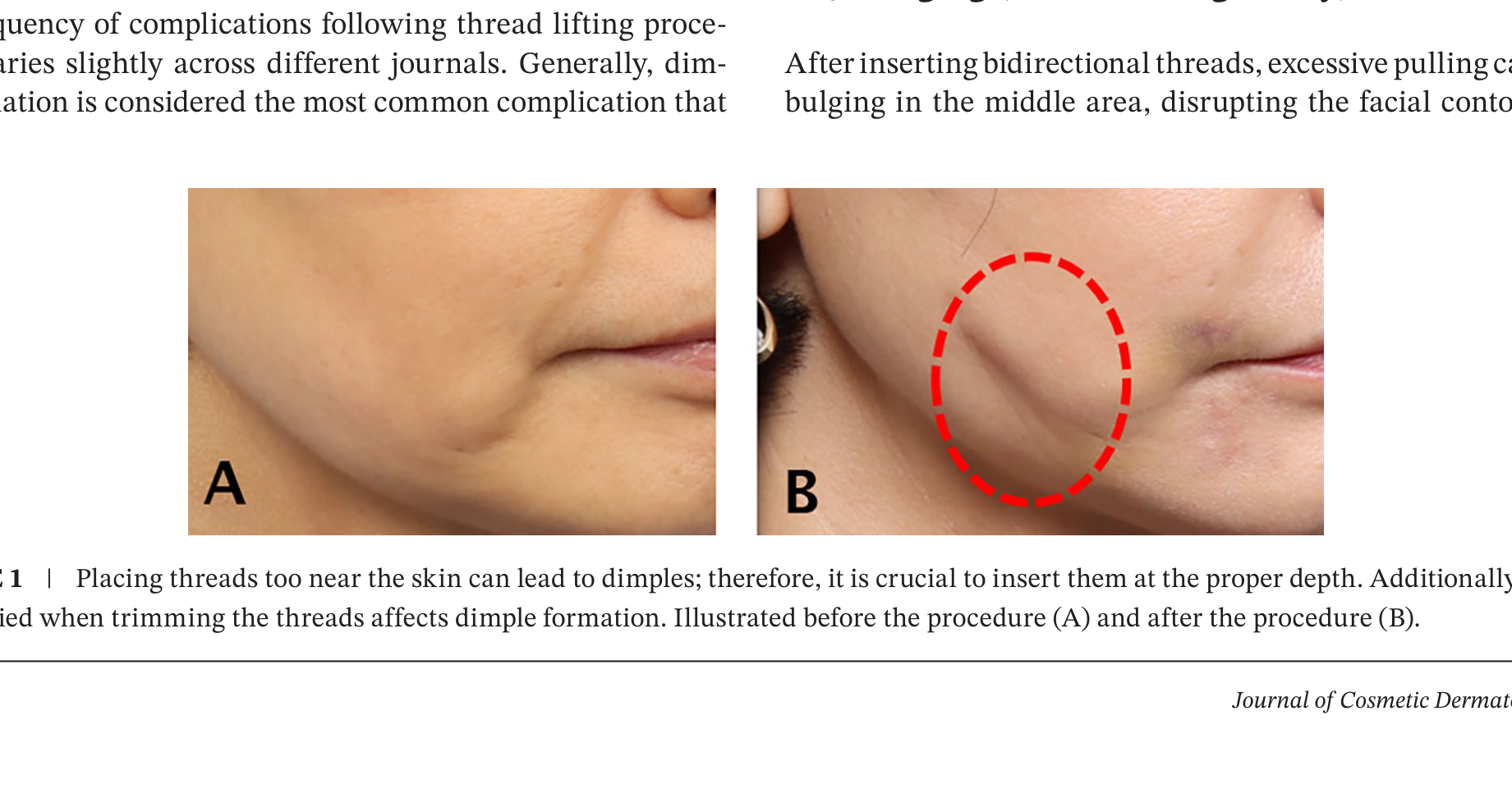
기전
- Cog가 dermal-subdermal junction에 과도하게 가까이 위치
- Excessive traction으로 인한 skin depression
- Dimple depth가 깊을수록 resolution이 느림
Management
- Mild: Massage로 자연 해소 (1~2주)
- Moderate: Thread tension 재조정, filler injection
- Severe: Thread removal 고려
예방: 적절한 depth (supra-SMAS), 과도한 tension 회피, insertion angle 조절.
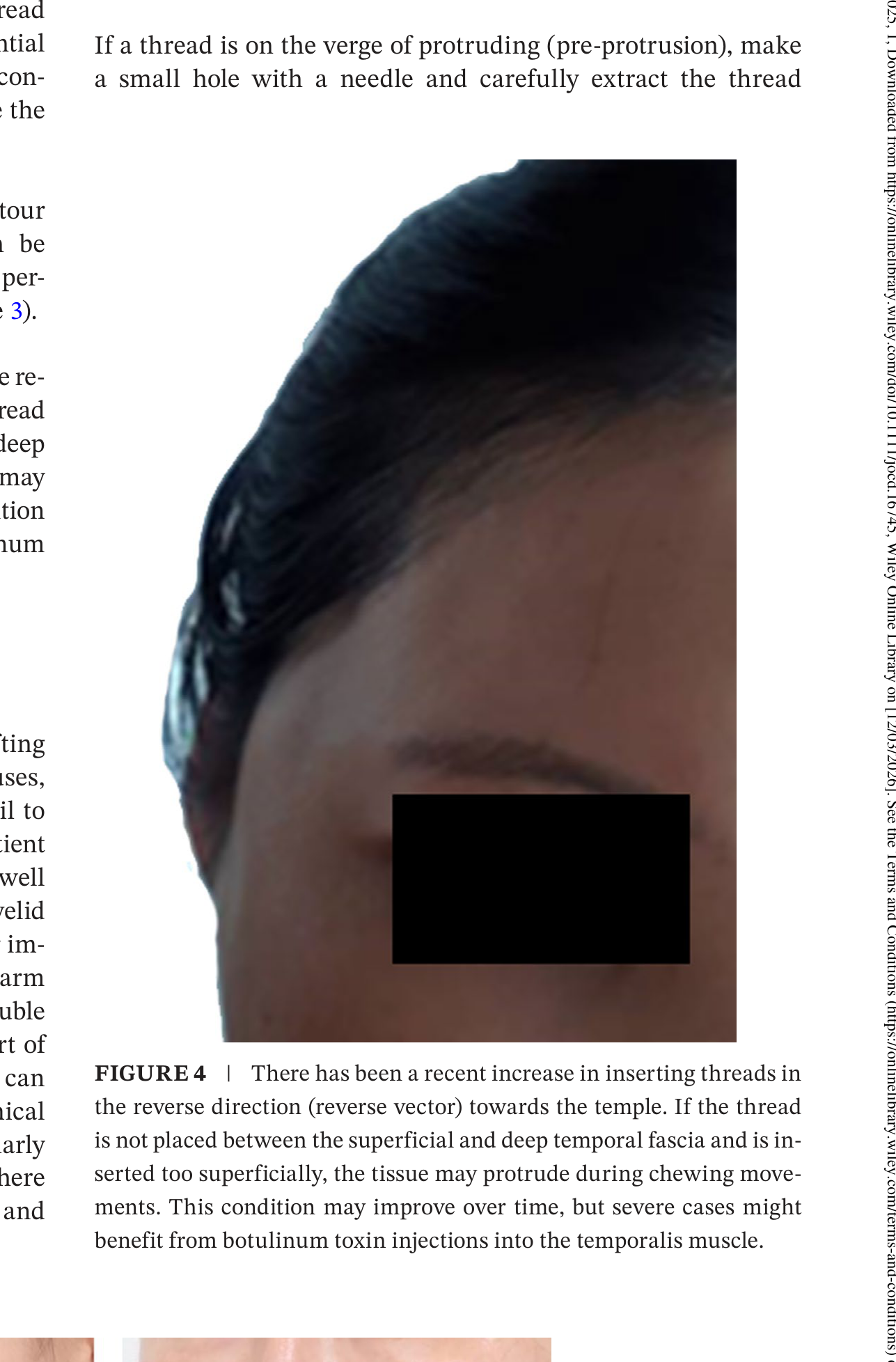
Contour Irregularity
- Bulging: thread 주변 tissue bunching
- Reverse vector: 의도와 반대 방향 lifting → 부자연스러운 외형
- Management: massage, thread repositioning, 필요 시 removal
Thread Migration
- Thread가 원래 위치에서 이동
- 원인: 불충분한 anchoring, 과도한 facial movement, 부적절한 depth
- 심한 경우 thread 노출 또는 감염으로 진행
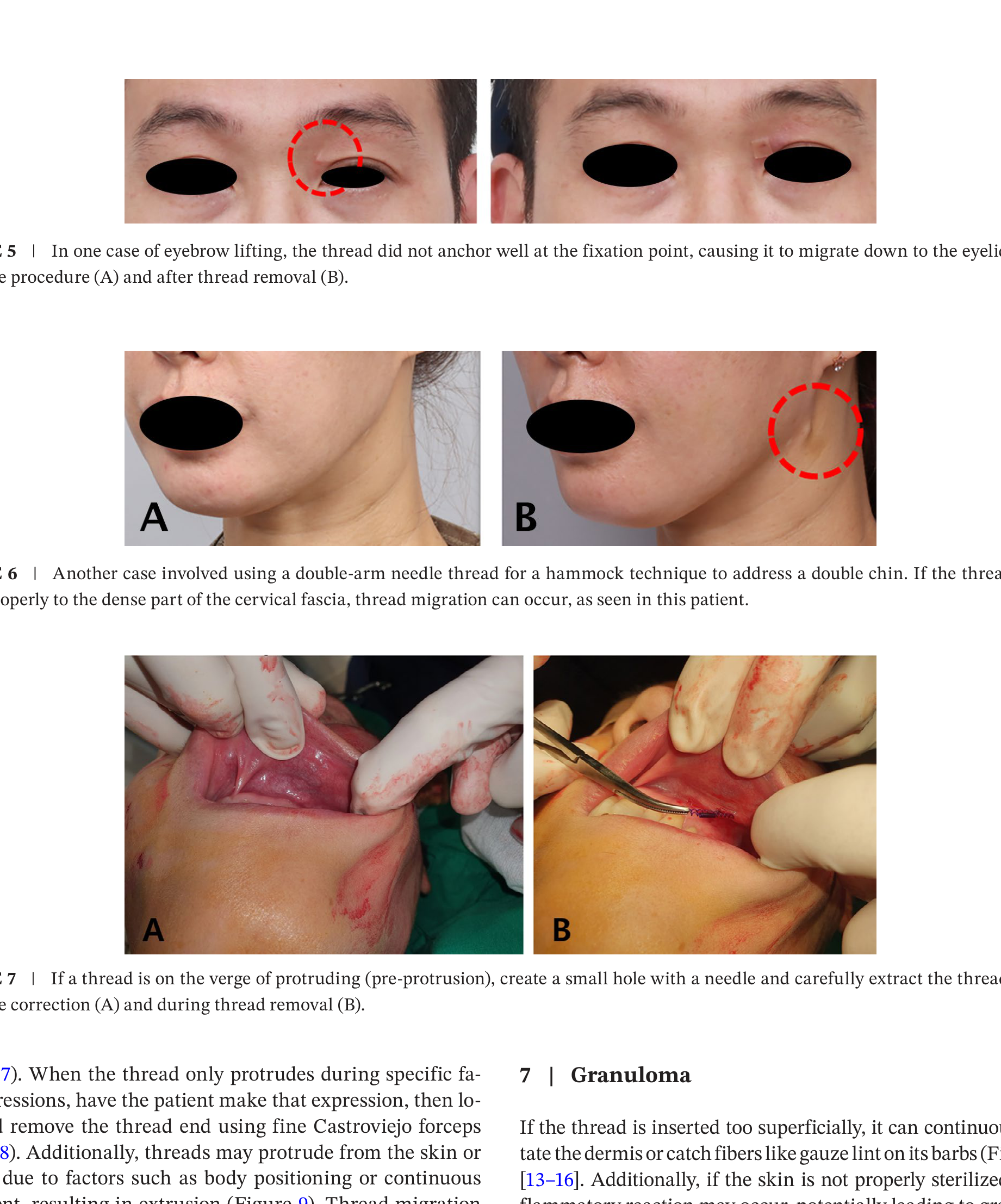
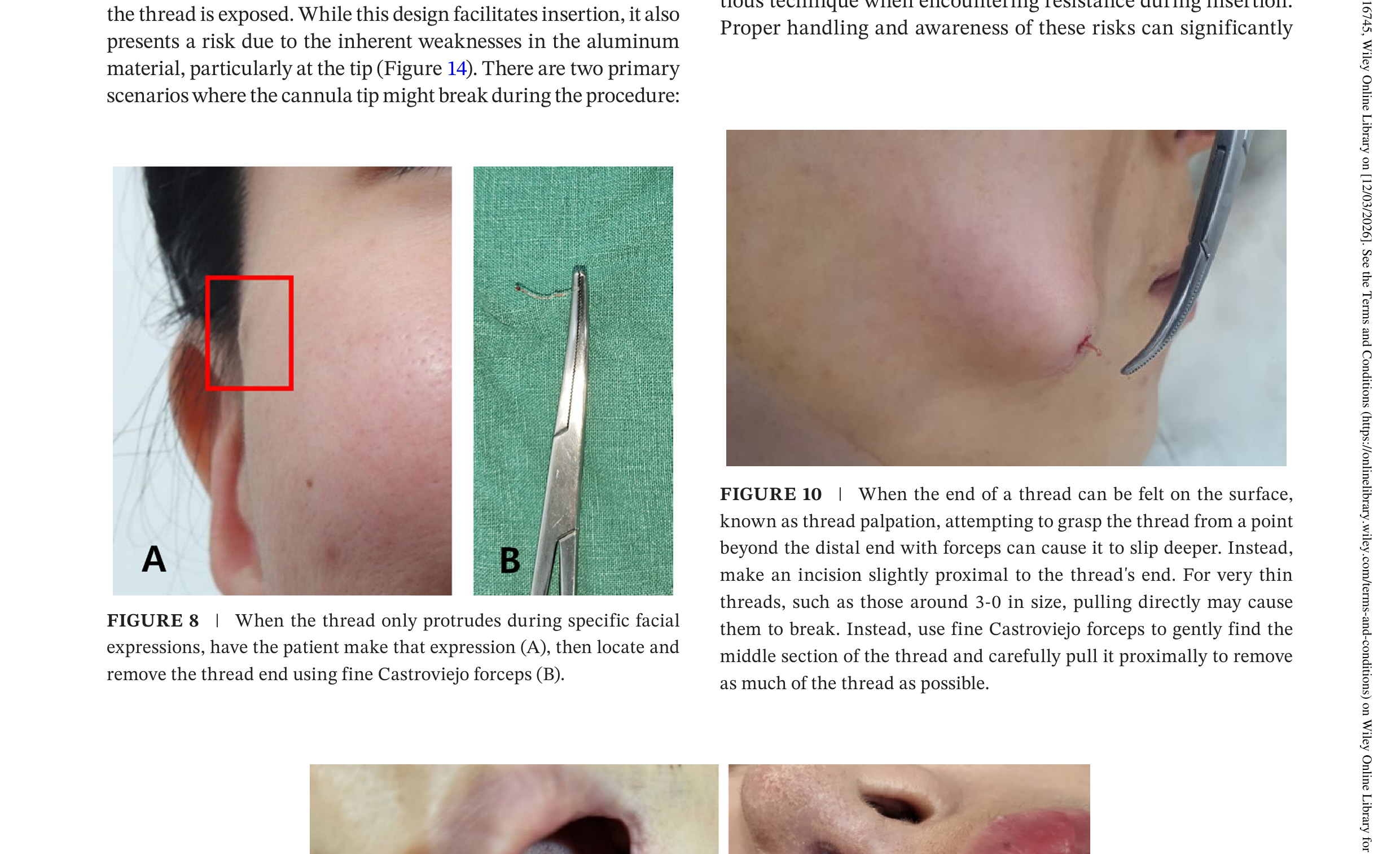
Pre-protrusion
Thread tip이 피부 표면 바로 아래에 촉지되는 상태. 아직 피부를 관통하지 않음. 조기 발견 시 간단한 repositioning으로 해결.
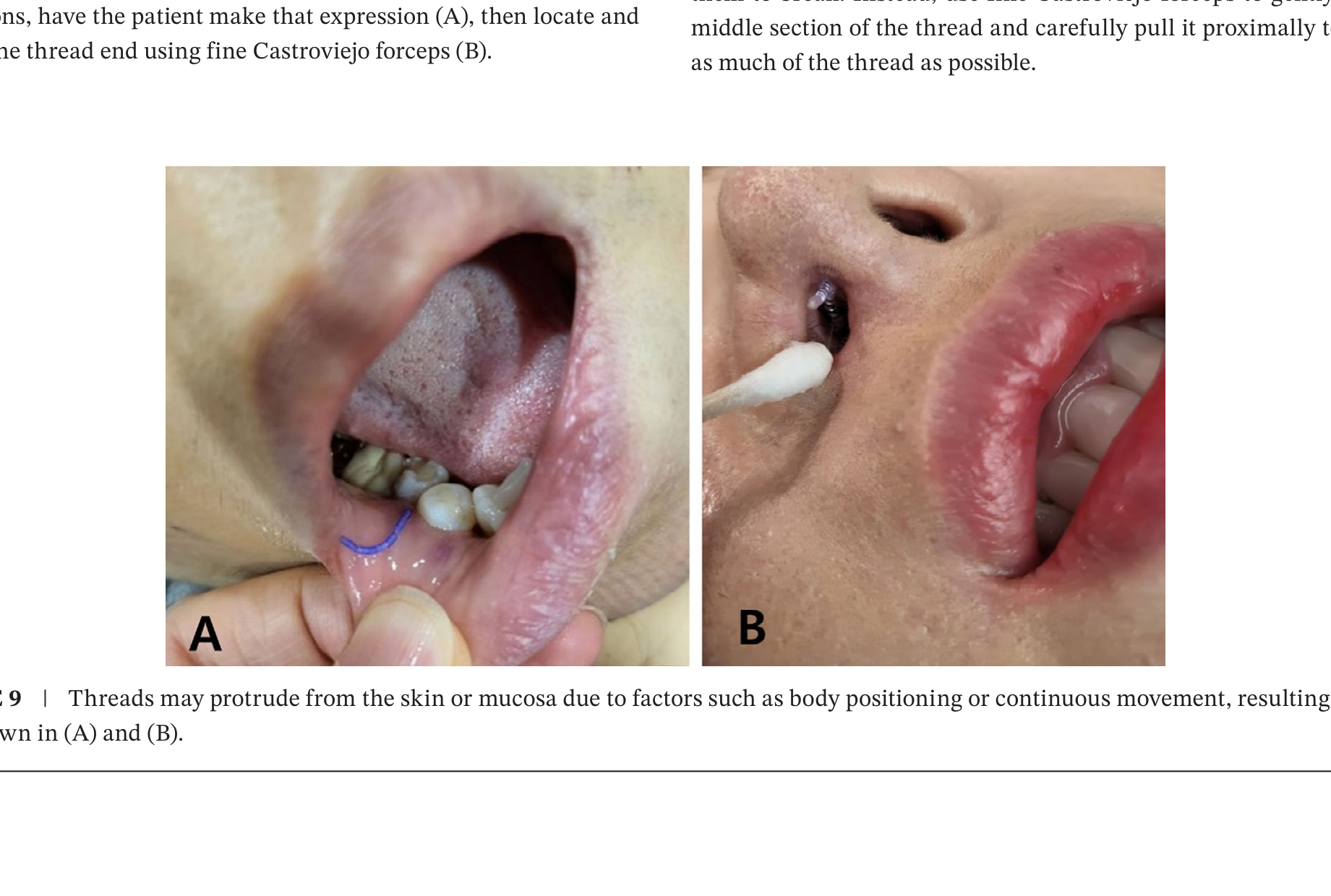
Protrusion / Extrusion
- Thread end가 피부를 관통하여 노출
- 원인: superficial insertion, facial animation에 의한 migration
- Management: 노출 부위 소독 + thread trimming 또는 removal
- 감염 동반 시 항생제 + 완전 제거
Thread Palpation
- 피부 아래에서 thread가 만져지는 상태
- 원인: superficial insertion, thin skin
- Volume thread에서 더 흔함
- Management: deep reinsertion, filler camouflage
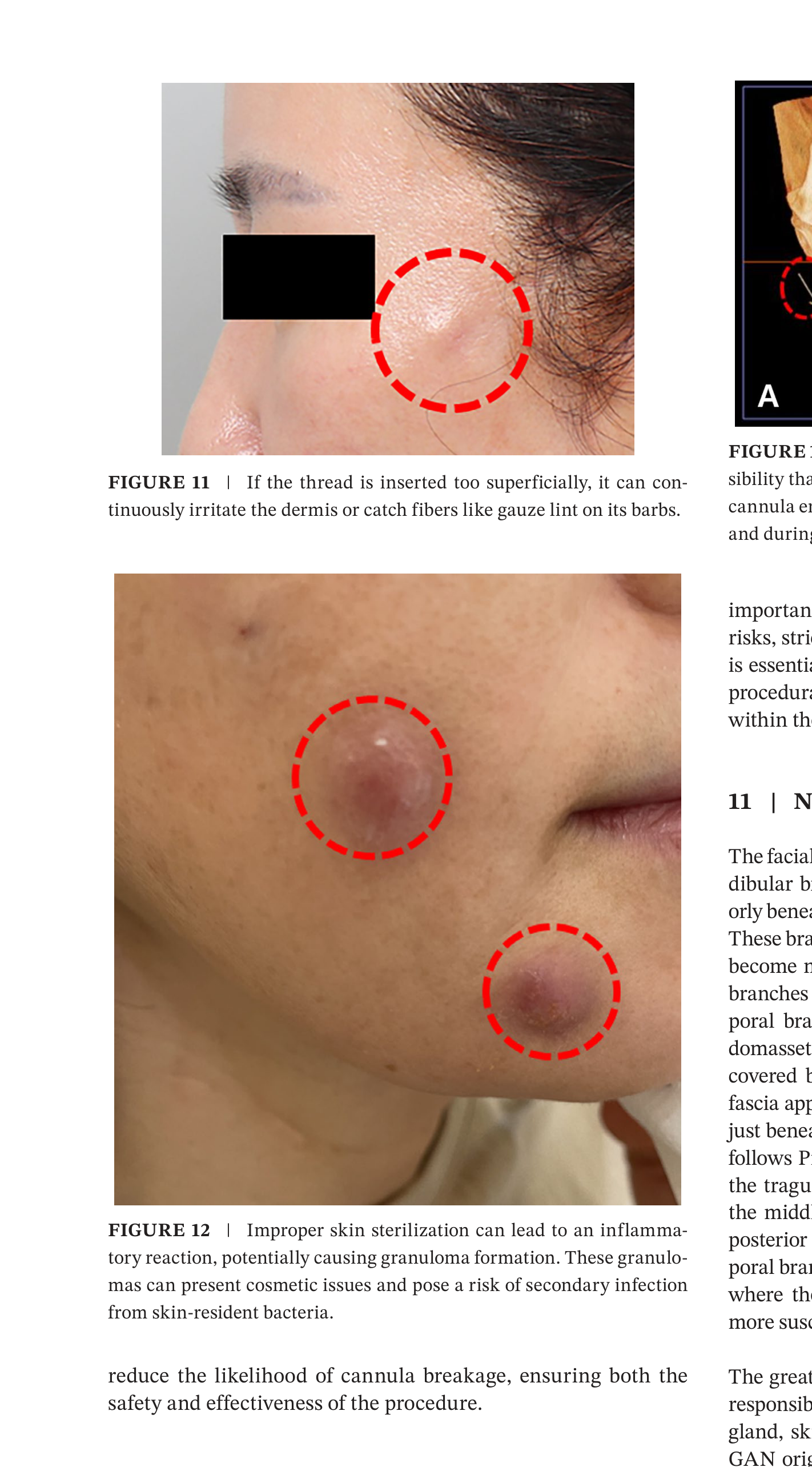
Granuloma
- Foreign body reaction으로 인한 nodule 형성
- Thread 주변 chronic inflammatory response
- Management: intralesional steroid injection, 필요 시 excision
- Non-absorbable thread에서 발생 빈도 ↑
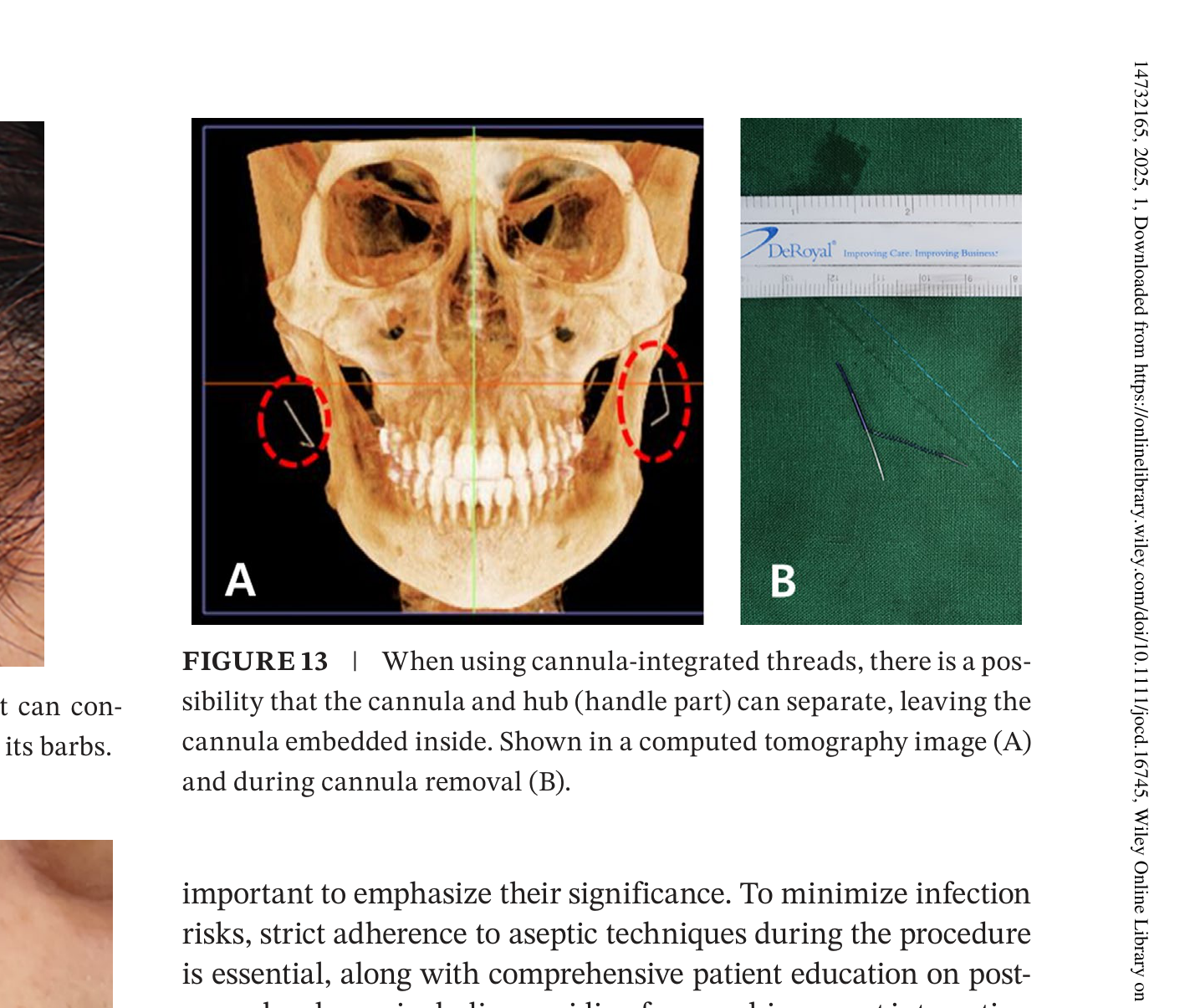
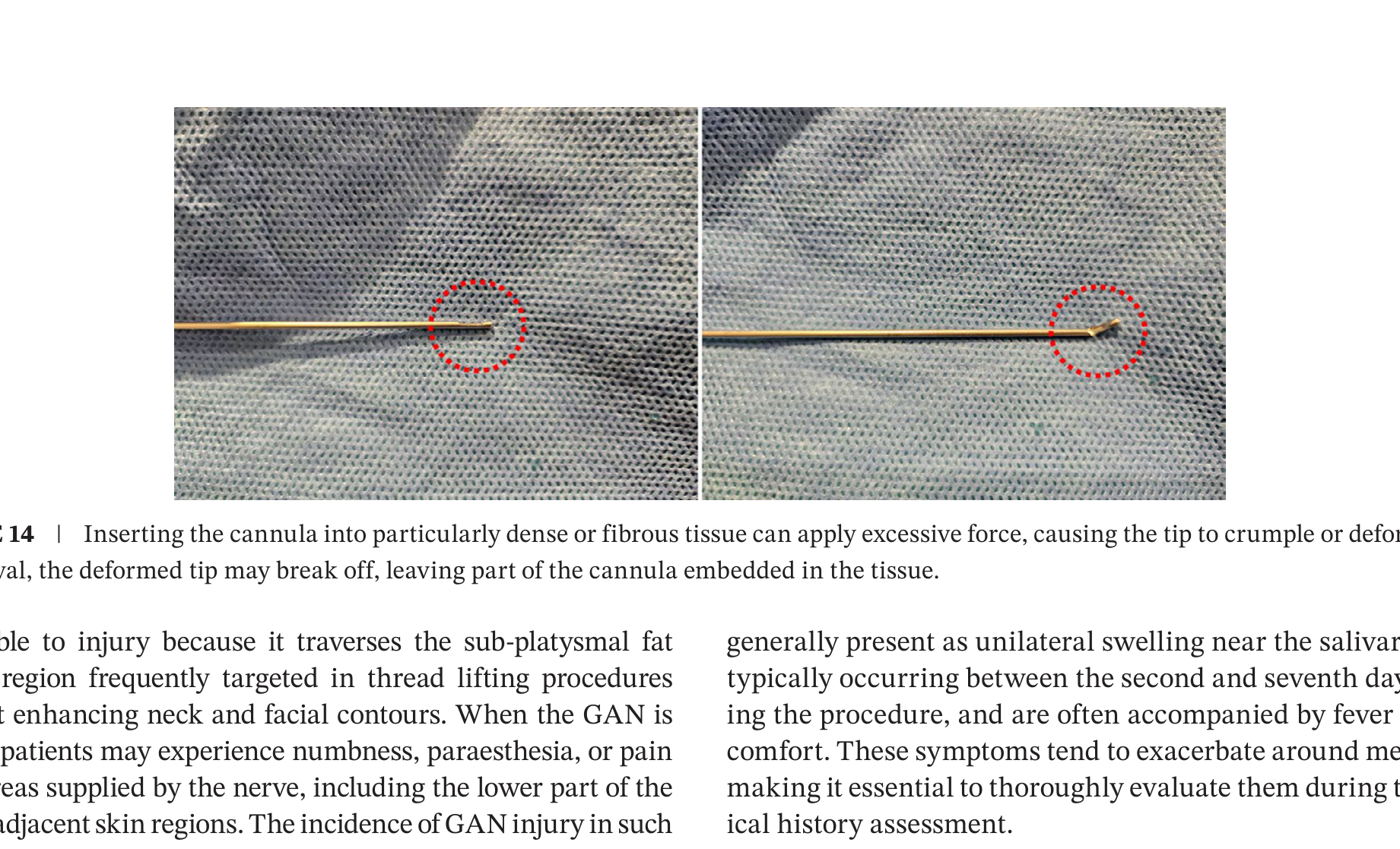
발생 기전
- Cannula tip이 시술 중 파손되어 조직 내 잔류
- 주로 금속 cannula 사용 시 발생
- CT에서 금속 artifact로 발견 가능
Management
- 무증상 시: 경과 관찰 가능
- 통증/감염 동반 시: image-guided removal
- 예방이 핵심: cannula integrity 확인, 과도한 force 금지
Facial Nerve Injury
- Temporal branch: eyebrow ptosis, forehead paralysis
- Marginal mandibular: lip asymmetry, drooling
- 대부분 neuropraxia (일시적) → 수주~수개월 내 회복
- Sub-SMAS insertion에서 risk 현저히 증가
GAN (Great Auricular Nerve) Injury
- Thread lifting 시 6% injury rate (가장 흔한 nerve injury)
- Ear lobule numbness, periauricular paresthesia
- Erb's point 근처 thread insertion 시 주의
- 대부분 자연 회복되나 수개월 소요
Parotid Gland Injury
- Thread가 parotid capsule 관통 시 sialocele 발생
- Preauricular area에서 과도한 depth 시 위험
- Management: aspiration, pressure dressing, botulinum toxin injection
- 예방: supra-SMAS placement, 해부학적 landmark 숙지
Hematoma
- Vascular injury로 인한 blood collection
- STA, TFA, facial artery 손상 시 발생
- Management: cold compress, aspiration, pressure
- 예방: 항응고제 중단 확인, vascular landmark 파악, blunt cannula 사용 권장
Lateral Canthus Elevation
Temporal area의 과도한 lifting → lateral canthus가 상방 견인되어 부자연스러운 "cat eye" 외형. Thread 수와 tension 조절로 예방.
1. Material Selection
Absorbable cog thread (PDO/PLLA/PCL)가 현재 주류. Lifting + tissue regeneration 동시 달성. 목표 지속 기간에 따라 소재 선택.
2. Design Matters
I/U/V-type 각각의 장단점 이해. Thread 방향보다 tissue consistency가 결과를 좌우.
3. Anatomy is Everything
Supra-SMAS placement, vascular/neural danger zones 숙지, retaining ligaments 활용. Ultrasound guidance 적극 권장.
4. Complication Management
예방이 최선. GAN injury 6%, dimpling 가장 흔함. 적절한 depth, tension, anatomical knowledge가 합병증을 최소화.
1
Hong GW et al. Basic concepts in facial and neck thread lifting. J Cosmet Dermatol. 2024.
2
Hong GW et al. Thread Lifting Materials. J Cosmet Dermatol. 2024.
3
Hong GW et al. Anatomical Considerations for Thread Lifting. J Cosmet Dermatol. 2025.
4
Yi KH, Park HJ. Complications of Thread Lifting. J Cosmet Dermatol. 2025.